

How Airbnb Turnover Speed Directly Affects Your Revenue (And How to Fix It)

“Faster turnovers. Fuller calendars. Higher revenue.”
Every hour your Airbnb sits empty between guests is money you'll never get back. Fast turnovers — powered by checklists, automation, linen systems, and a reliable Airbnb turnover cleaning service in Austin or your market — can boost occupancy by double digits and command 15–25% higher nightly rates. Below, we break down exactly why speed matters and how to build a turnover system that keeps your calendar full.
The Gap Night Problem: How Slow Turnovers Silently Drain Your Income
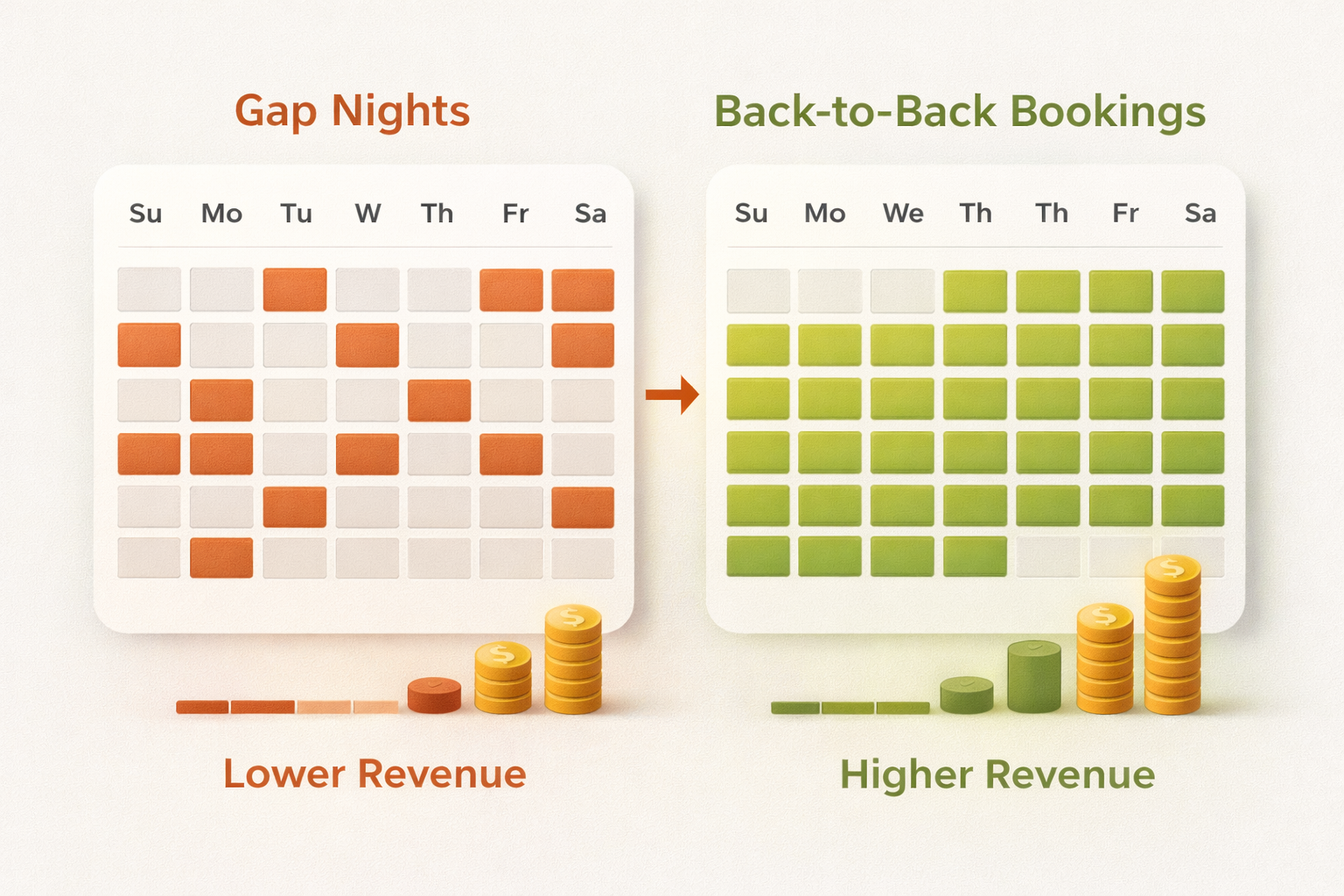
“Every empty night isn’t just lost time—it’s lost revenue caused by slow turnovers.”
Here's a number that should keep every Airbnb host up at night: a single blocked cleaning day at a $200 average daily rate costs you $200 in pure lost revenue. Do that twice a month, and you've given away $4,800 a year — before you've even factored in the ranking damage.
Turnover speed — how quickly you clean, restock, and prepare your property between guests — is one of the most underrated revenue levers in short-term rental hosting. In a market increasingly driven by last-minute bookings, the property that's guest-ready by 2 PM gets the 3 PM reservation. The one still waiting on a cleaner doesn't.
Yet most hosts treat turnovers as an operational afterthought rather than a revenue strategy. Industry analysts call the resulting downtime "the silent killer of STR margin," and the label fits. Every gap night on your calendar is a night your competitors are filling.
Faster Turnovers Mean More Bookings and Higher Rates

“Faster turnovers don’t just save time—they unlock more bookings and higher nightly rates.”
The math is straightforward: fewer empty nights equals more revenue. But the compounding effects go further than most hosts realize
The Occupancy Boost
Professional hosts who streamline their Airbnb cleaning turnaround time see measurable results. One Memphis-based property manager reported that after tightening turnovers to capture same-day and next-day bookings, their listings earned roughly a 9% nightly rate premium ($151 vs. $138 average) and doubled their listing views. That's not a marginal improvement — it's a fundamentally different business.
The Cleanliness-Revenue Flywheel
Thorough turnovers don't just open calendar nights. They generate the cleanliness scores that fuel Airbnb's search algorithm. Listings with consistently high cleanliness ratings achieve around 90% occupancy and command 15–25% higher nightly rates compared to average properties.
This creates a flywheel effect: fast, thorough turnovers lead to better reviews, which lead to higher search rankings, which lead to more bookings at better rates — which justify investing even more in your turnover process.
Last-Minute Booking Capture
Same-day and next-day reservations are among the highest-margin bookings you can get. Guests booking last-minute are less price-sensitive and often willing to pay full rate. But you can only capture them if your property is ready. A cleaning operation built for speed turns these otherwise-missed opportunities into real revenue.
The Real Cost of Slow Turnovers

“Slow turnovers quietly kill Your profit.”
Slow turnovers don't just cost you one night's revenue. The damage compounds across three dimensions:
Lost Booking Revenue
This is the obvious hit. If your cleaner can't get in until the next morning, you block tonight. At a $200 ADR, that's $200 gone — not deferred, gone. Over a year, even occasional gap nights add up to thousands in lost income.
Damaged Rankings and Reviews
A rushed turnover to avoid a gap night is almost worse than a slow one. Guests notice missed details: a hair on the bathroom counter, a streaky mirror, yesterday's coffee grounds still in the filter. Airbnb cleaning is consistently the single biggest factor in guest satisfaction scores.
Here's why that matters structurally: even one cleanliness complaint can drag your overall rating below the critical 4.7-star threshold. Once you dip below that line, Airbnb's search algorithm suppresses your listing. Fewer impressions mean fewer bookings, which means less review volume to recover your score. It's a downward spiral that starts with one sloppy turnover.
Operational Drag
Beyond direct revenue loss, slow processes consume your time and attention. Every hour spent coordinating cleaners, managing laundry logistics, and chasing down missing supplies is an hour you're not spending on pricing strategy, guest communication, or scaling your portfolio. The hidden labor costs of inefficient turnovers — cleaning coordination, linen handling, downtime management, re-marketing blocked nights — erode your profit margin from multiple angles.
How to Speed Up Your Airbnb Turnovers: 8 Proven Tactics

“Speed up your turnovers—and watch your calendar fill up.”
The good news: turnover speed is a solvable problem. Here are eight specific strategies that professional STR operators use to cut turnover time without sacrificing quality.
1. Hire a Specialized STR Cleaning Team
General house cleaners and Airbnb turnover cleaners are different skill sets. A dedicated short-term rental cleaning service understands the pace, the checklist mentality, and the hospitality-grade finish that guests expect. They bring enough crew members to parallelize tasks and finish faster.
If you’re an Austin host, look for a team that focuses exclusively on STR turnovers — companies like HappyCleanBnB that handle same-day cleans as standard practice, not as a special request.
2. Adopt a 3-Set Linen System
This single change can cut 30–45 minutes off a turnover. Instead of washing sheets and waiting for them to dry during the clean, keep three complete sets per bed:
Set A is on the bed (currently in use by the outgoing guest).
Set B is freshly laundered and ready to go on.
Set C is in the wash cycle from the previous turnover.
Your cleaners strip the beds, swap in Set B immediately, and bag Set A for off-site laundering. No waiting. No dryer delays. Beds are made in minutes.
3. Maintain PAR-Level Supply Stocks
Borrow a concept from hotel operations: set minimum stock levels (called PAR levels) for every consumable — toilet paper, soap, coffee, trash bags, cleaning products. Use labeled bins or a dedicated supply closet so your cleaning team never wastes time on a mid-turnover shopping run.
A practical rule of thumb: keep enough stock on hand for at least three full turnovers. Restock weekly on a set schedule, not reactively.
4. Automate Cleaning Scheduling
Stop texting your cleaners every time a guest checks out. Tools like Turno (formerly TurnoverBnB) or iGMS integrate directly with your Airbnb calendar and auto-assign cleanings the moment a checkout is confirmed. Your cleaner gets a push notification with the address, checklist, and timeline — no phone calls required.
5. Build and Use a Room-by-Room Checklist
An Airbnb turnover checklist isn't just a training tool — it's a speed tool. When cleaners follow a standardized, room-by-room sequence, they don't waste time deciding what to do next or doubling back to rooms they've already left. A good checklist also ensures consistency: any cleaner, even a first-timer, can deliver a reliable result.
6. Optimize Your Task Sequence
The order matters. A proven approach for a two-person team on a 2-bedroom unit (target: around 4 hours):
First 30 minutes: Strip beds, start laundry (if on-site), spray bathrooms to let products soak.
Middle block: One person tackles bathrooms and bedrooms; the other handles the kitchen and common areas.
Final 30 minutes: Regroup for living spaces, restock supplies, stage the property.
Last 15 minutes: Joint walkthrough inspection using your checklist.
Build in a 15–30 minute buffer for unexpected issues. Rushing the final check is where mistakes happen.
7. Invest in the Right Equipment
Small upgrades make a measurable difference. A commercial-grade vacuum cuts floor time in half compared to a consumer model. Microfiber cloths clean surfaces in one pass instead of three. A caddy or cleaning cart keeps supplies mobile so your team isn't walking back and forth to a supply closet.
Digital photo-check systems also speed up quality control. Cleaners photograph each room when finished, so you (or your property manager) can verify remotely without a physical walkthrough.
8. Always Have a Backup Plan
Back-to-back bookings leave zero room for a no-show cleaner. Confirm coverage for every turnover in advance, and have an on-call backup — either a second cleaner or a relationship with a professional STR cleaning company that can dispatch a replacement on short notice.
HappyCleanBnB: Built for Austin's Back-to-Back Booking Pace

“Powered by systems. Delivered by HappyCleanBnB.”
For Austin hosts who want to stop worrying about turnovers and start maximizing occupancy, HappyCleanBnB is purpose-built for the job.
Their operation addresses the specific challenges outlined above. HappyCleanBnB syncs directly with your Airbnb calendar, so cleanings are auto-scheduled the moment a guest checks out — no manual coordination. Their trained teams arrive with fresh linens, restock essentials, and document every clean with pre- and post-photos. It's a hotel-grade process applied to short-term rentals.
What sets them apart is focus. Because the entire company is built around Airbnb turnovers, they handle tight same-day schedules as routine — not as emergencies. They also offer add-on services like trash removal, pool checks, and minor maintenance tasks, so you can consolidate your turnover logistics with a single provider.
For hosts who've lost bookings to slow turnovers or taken a rating hit from a rushed clean, hiring a specialized Austin turnover cleaning company like HappyCleanBnB is often the single highest-ROI operational change they can make.
The Bottom Line
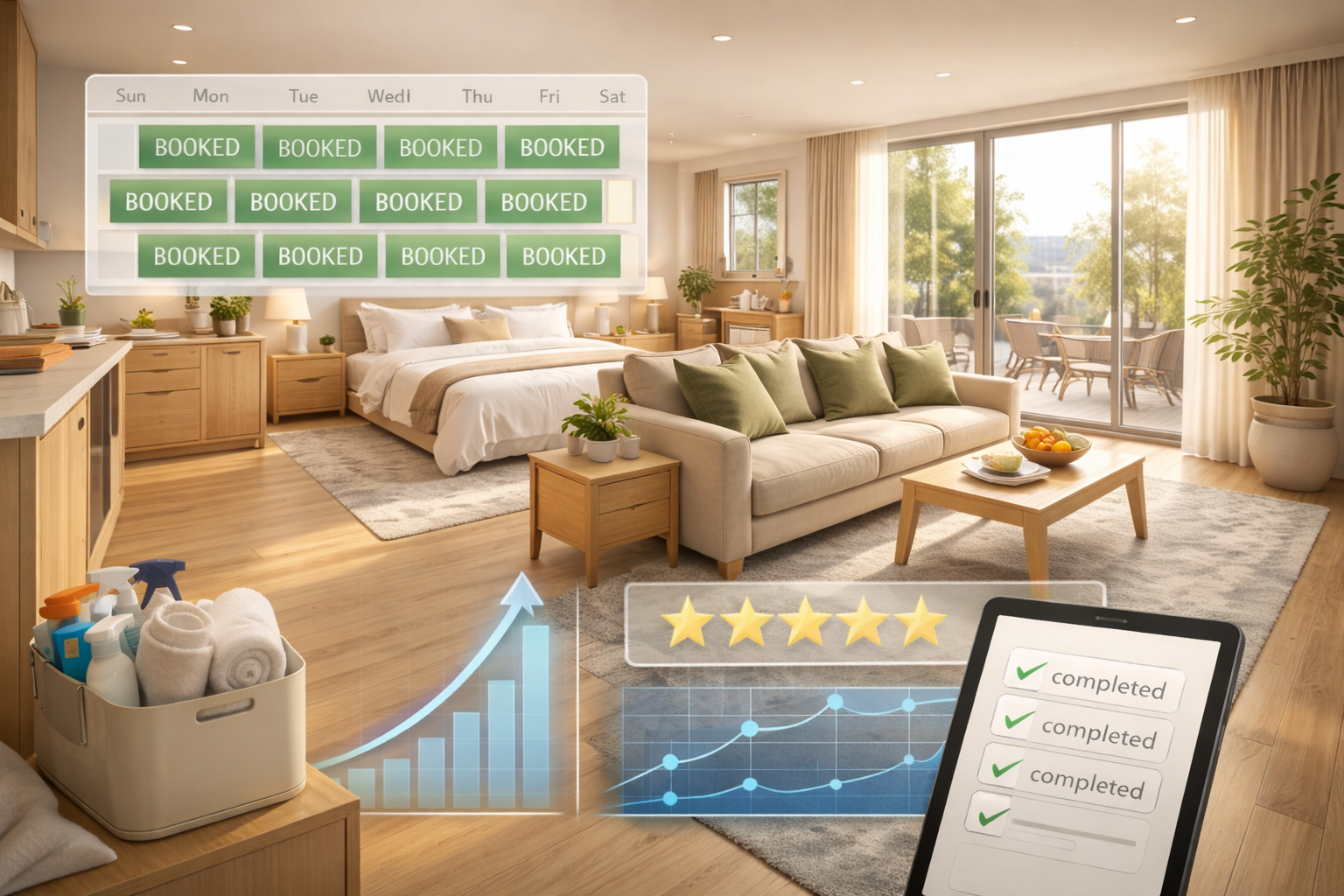
“Turnover speed is the hidden lever behind higher occupancy and stronger reviews.”
Airbnb turnover speed directly affects your revenue in two ways: it determines how many nights you can actually rent, and it shapes the guest experience that drives your reviews, rankings, and pricing power.
The hosts who treat turnovers as a core revenue strategy — not just a chore — consistently outperform those who don't. They invest in systems (3-set linens, automated scheduling, standardized checklists) and partnerships (dedicated STR cleaning teams) that keep their properties guest-ready faster and more reliably.
If you take one thing from this post, make it this: every hour you shave off your turnover is an hour your listing can earn money. That's not a marginal optimization. Over a year, it's the difference between a good Airbnb business and a great one.
Ready to eliminate gap nights? Get a quote from HappyCleanBnB and see how a same-day turnover system can change your numbers — or start by implementing the 3-set linen system and automated scheduling this week. Your calendar (and your bank account) will notice the difference
