

How Many Sheet Sets Does an Airbnb Need? The Host's Linen Inventory Guide
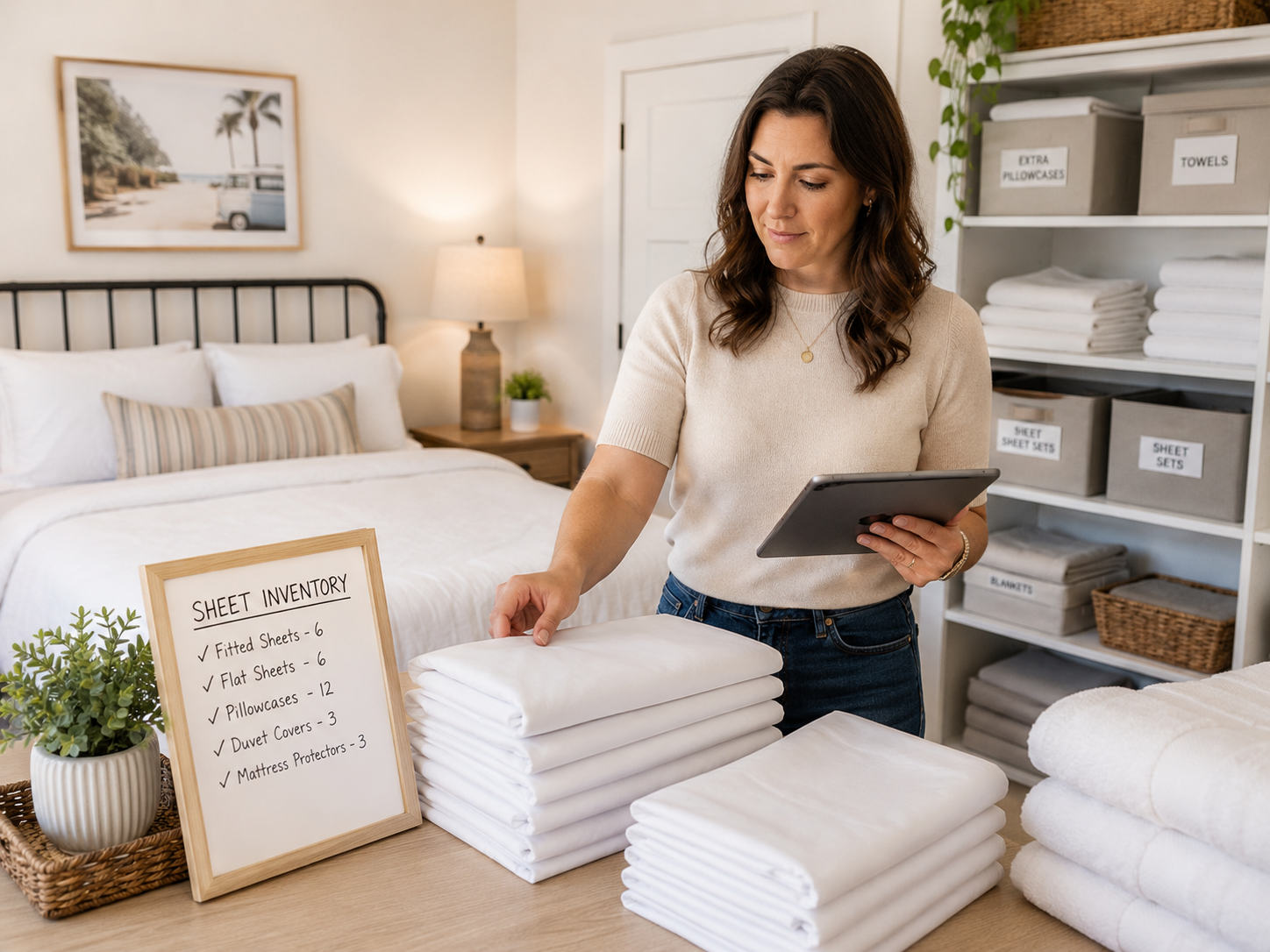
A well-stocked sheet inventory is one small detail that makes a big difference in Airbnb hosting.
A perfectly cleaned unit still isn't guest-ready if the sheets are tumbling in the dryer. That bottleneck is exactly why how many sheet sets an Airbnb needs is such a practical question — and why, for most listings, the answer is three complete sets per bed, not the one or two many hosts start with.
The reason has less to do with your guests and more to do with your laundry cycle. Get the math right and turnovers stop feeling like a sprint against the clock. Get it wrong and a single late wash can put your next check-in at risk.
Key takeaways
Baseline: three complete sheet sets per bed. This is the standard three-par rule — one set on the bed, one in the wash, one shelf-ready for the next turnover.
Total per listing = beds × 3. A two-bedroom listing with two beds needs six complete sets, not two.
Move to four sets per bed if you use off-site laundry, accept back-to-back or same-day bookings, or run a premium home where expectations are higher.
Towels follow the same logic. Airbnb's floor is one towel per guest; the premium benchmark (Airbnb Luxe) is at least two of each type per guest, sized to maximum occupancy. Rotate towels on the same par cycle as sheets.
Buy white, durable, bleachable linens that still look crisp after repeated washing.
The real constraint is laundry turnaround, not bed count. Plan inventory around how fast you can reset, not how many beds you have.
The short answer: three sheet sets per bed
For most standard listings, plan for three complete sheet sets per bed. Hospitality teams have managed linens this way for decades using a par-level system, and the simplest version is the three-par rule: one set is in use on the bed, one set is being washed or is in transit to the laundry, and one set sits clean and ready for the next turnover.
That third set is the whole point. It's the buffer that lets you remake a bed the moment a guest checks out, even if the previous set is still wet. Without it, every turnover depends on a wash cycle finishing on time — and same-day turns rarely leave room for "on time."
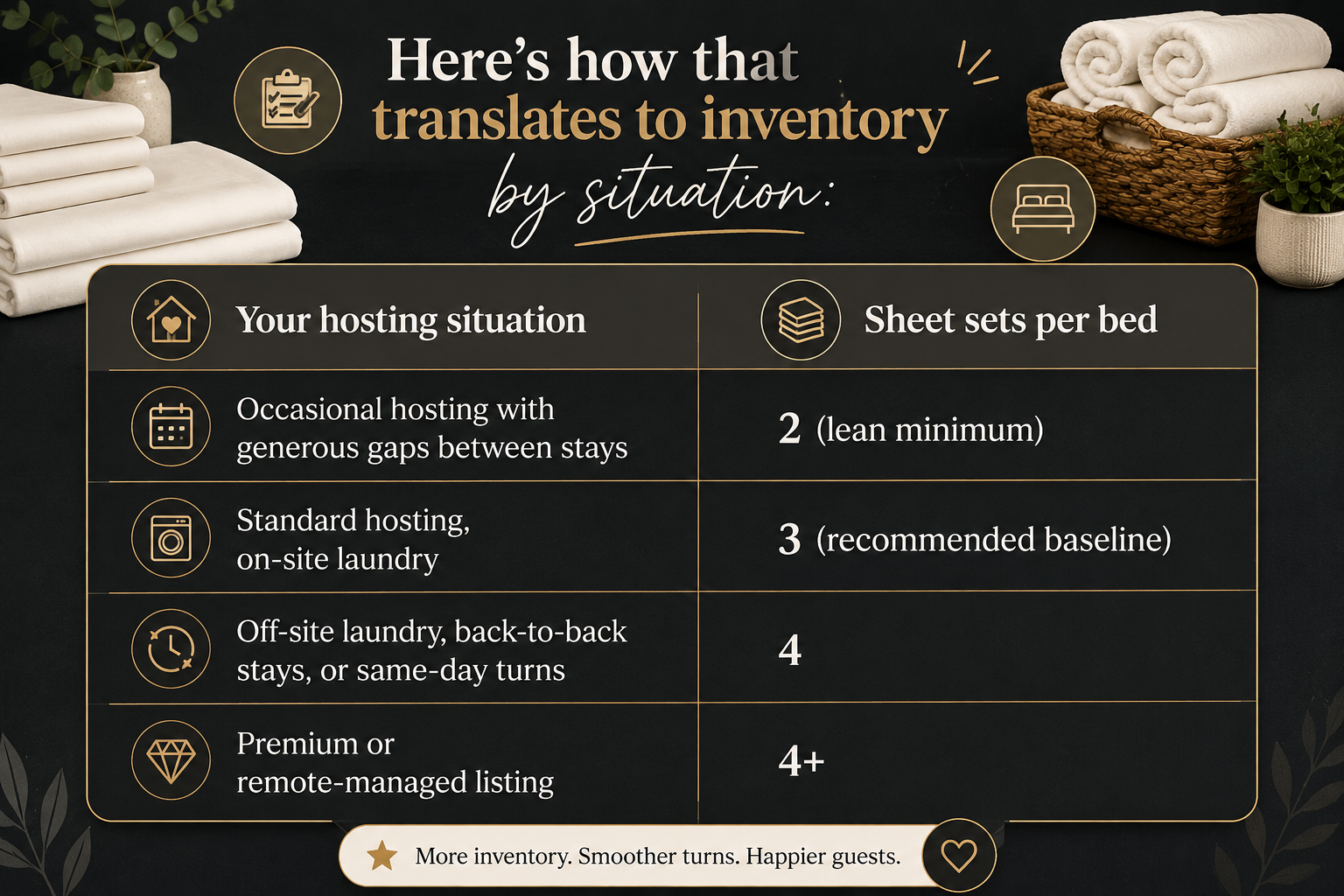
So a two-bedroom listing with two beds needs six complete sets at the three-par baseline. If you rely on off-site laundry or accept same-day bookings, eight sets is the safer number. Two sets per bed can work, but only if you build real preparation time between reservations — and that buffer costs you bookings.
Airbnb actually gives you a tool for that buffer: you can set up to two nights of preparation time between reservations. It's a useful safety valve, but every night you block for prep is a night you can't sell. Carrying an extra set of sheets is almost always cheaper than blocking a calendar.
Why your turnover speed decides your linen count — not your bed count
The instinct is to count beds and stop there. The better approach is to think like a hospitality operator: your linen count is a function of how fast you need to strip, wash, remake, and reset a home between reservations.
Airbnb's own hosting guidance tells hosts to keep extra sheets and towels on hand so they don't have to wait on laundry, and its ground rules require laundry as part of cleaning between every stay. Both point to the same conclusion — laundry is an inventory problem, not an afterthought.
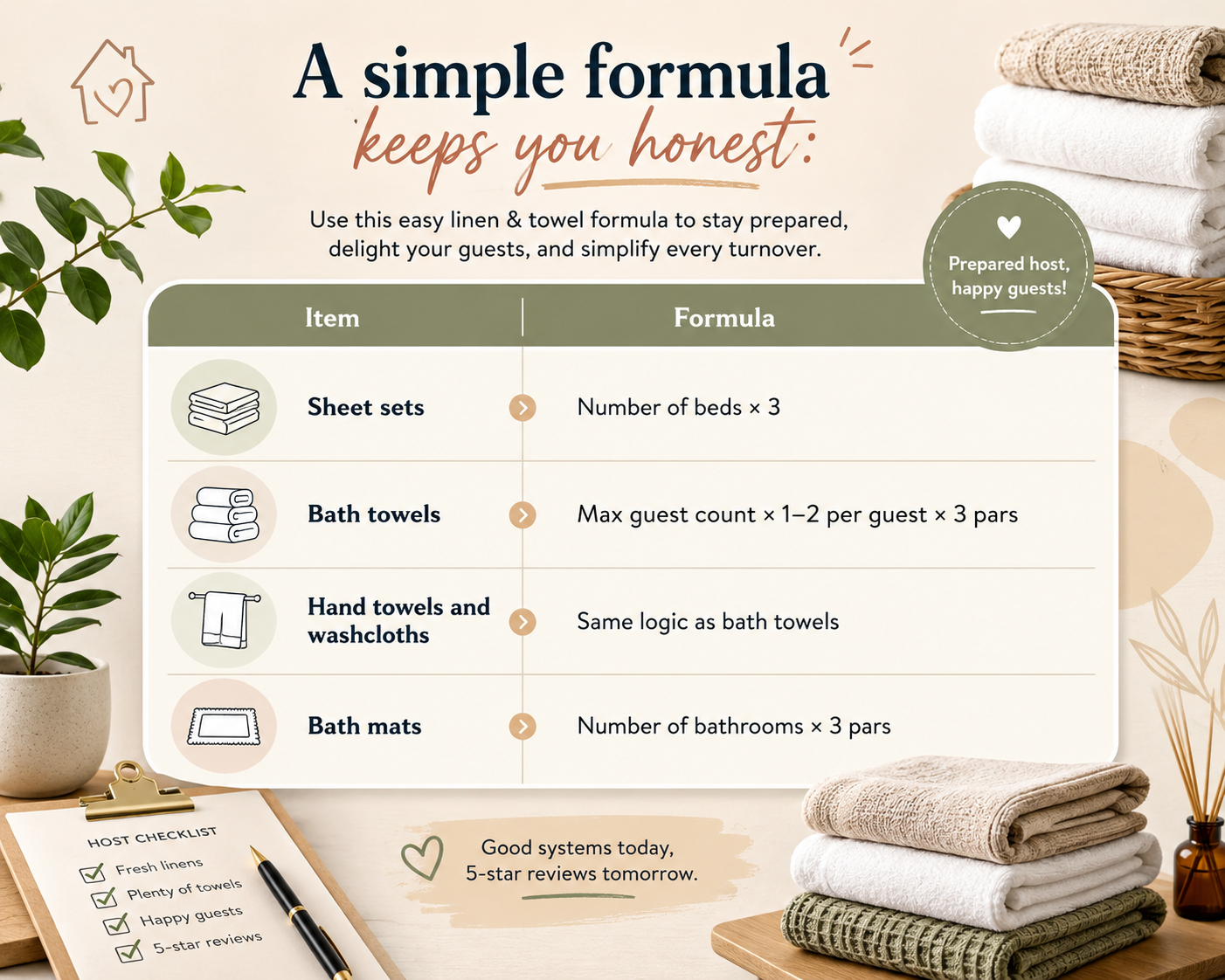
One rule matters more than the rest: size your inventory to maximum occupancy, not average occupancy. If your listing sleeps four, stock for four every time. The cost of running short on a busy weekend — an emergency wash, a delayed check-in, a "where are my towels?" message — is almost always higher than the cost of holding a few backup sets.
How many towels and sheets is "enough"? Minimum vs. five-star
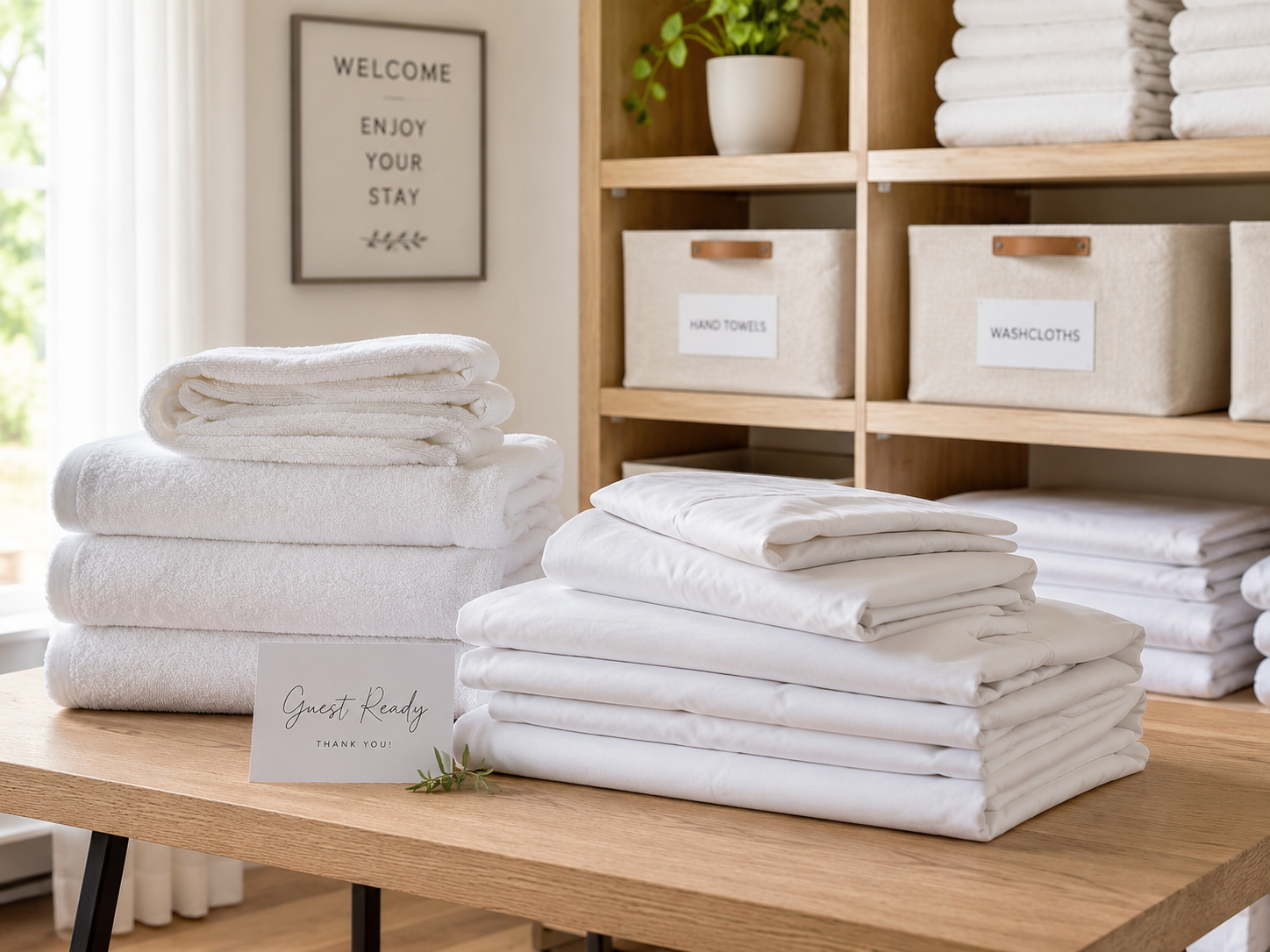
The goal isn’t just to have linens in the unit — it’s to have a system that works every time. Stock for guest comfort, then build enough backup to survive back-to-back turnovers.
It helps to separate two different standards: minimum compliance and five-star operations.
The minimum. Airbnb's guidance for preparing a home is straightforward — stock one towel and one pillow per guest, plus linens for every bed. That's the floor, and listings that claim the essentials amenity without actually providing it can face penalties, including removal.
The five-star standard. Airbnb Luxe, the platform's premium tier, sets a higher bar: additional linens and at least two towels of each type per guest, based on the home's maximum occupancy. You don't need to be a Luxe listing to borrow the benchmark. If your home is premium, remote-managed, or booked back-to-back, inventory toward this standard instead of the bare minimum.
The par overlay sits on top of both. Whatever quantity you decide a guest should find in the unit, multiply it across your three-par cycle so you can rotate without waiting on a dryer. That's the difference between a unit that's stocked and a system that's reliable.
The Airbnb linen and bedding checklist
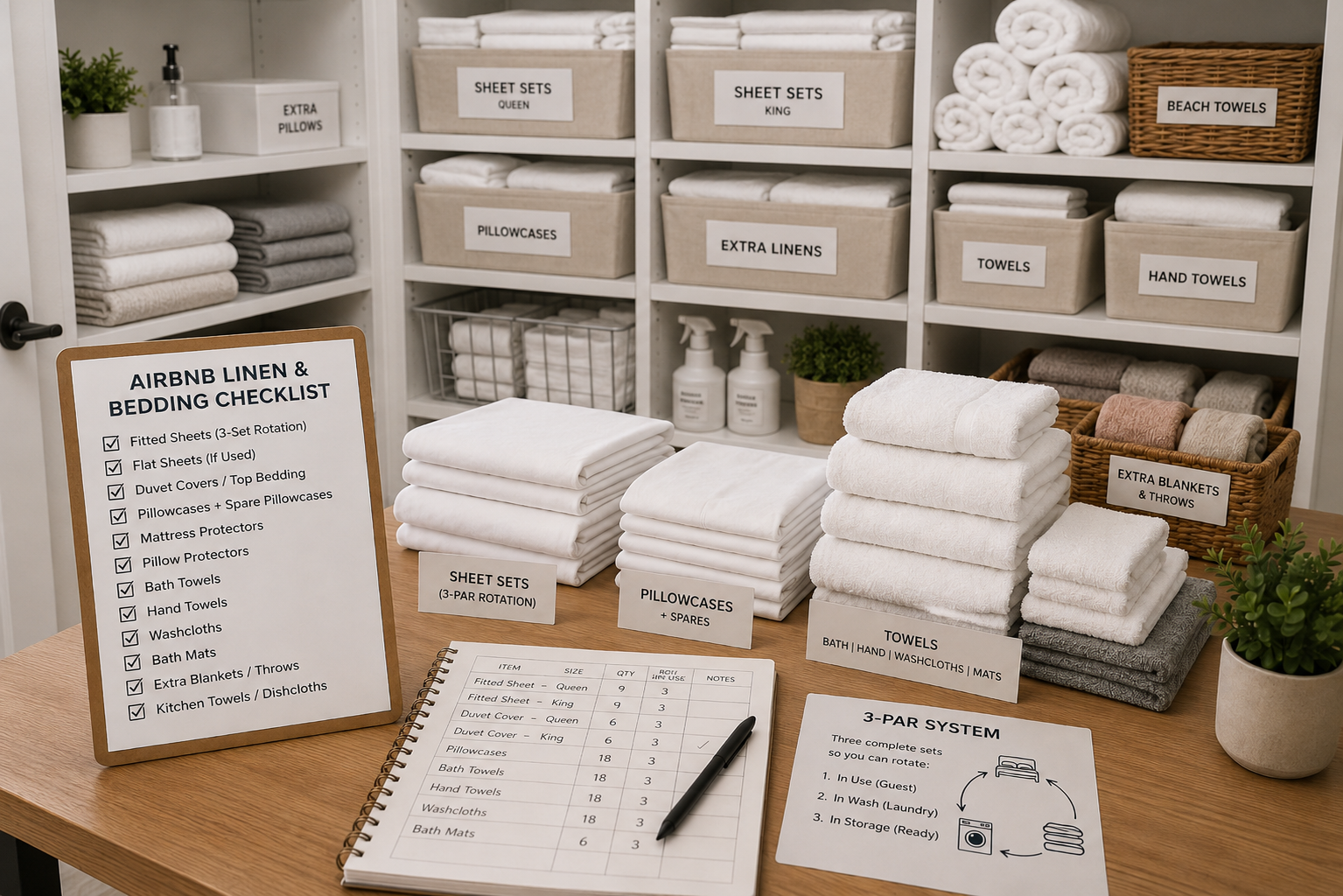
A complete checklist covers more than fitted sheets and bath towels. It accounts for the backup pieces that keep a small problem — a torn pillowcase, a stained duvet — from becoming a same-day crisis.
Here's the short-term rental linen checklist worth stocking for most homes:
Fitted sheet for every bed, in three-set rotation
Flat sheet, if your setup uses one, in matching rotation
Duvet cover or top bedding layer, in matching rotation
Pillowcases, plus spare pillowcases
Mattress protectors and pillow protectors
Bath towels, hand towels, washcloths, and bath mats sized to maximum occupancy and par level
Extra blankets or throws for guest comfort
Kitchen towels or dishcloths if the home includes kitchen access
If you want the tighter bedding-only core — the items that directly affect how fast you can reset a bed — focus here: fitted sheet, flat sheet (if used), duvet cover or comforter layer, pillowcases, mattress protector, pillow protectors, and a ready-to-deploy backup set in storage. That backup set is what turns a bed reset from a gamble into a routine.
What makes the best sheets for an Airbnb (hint: durability, not just softness)
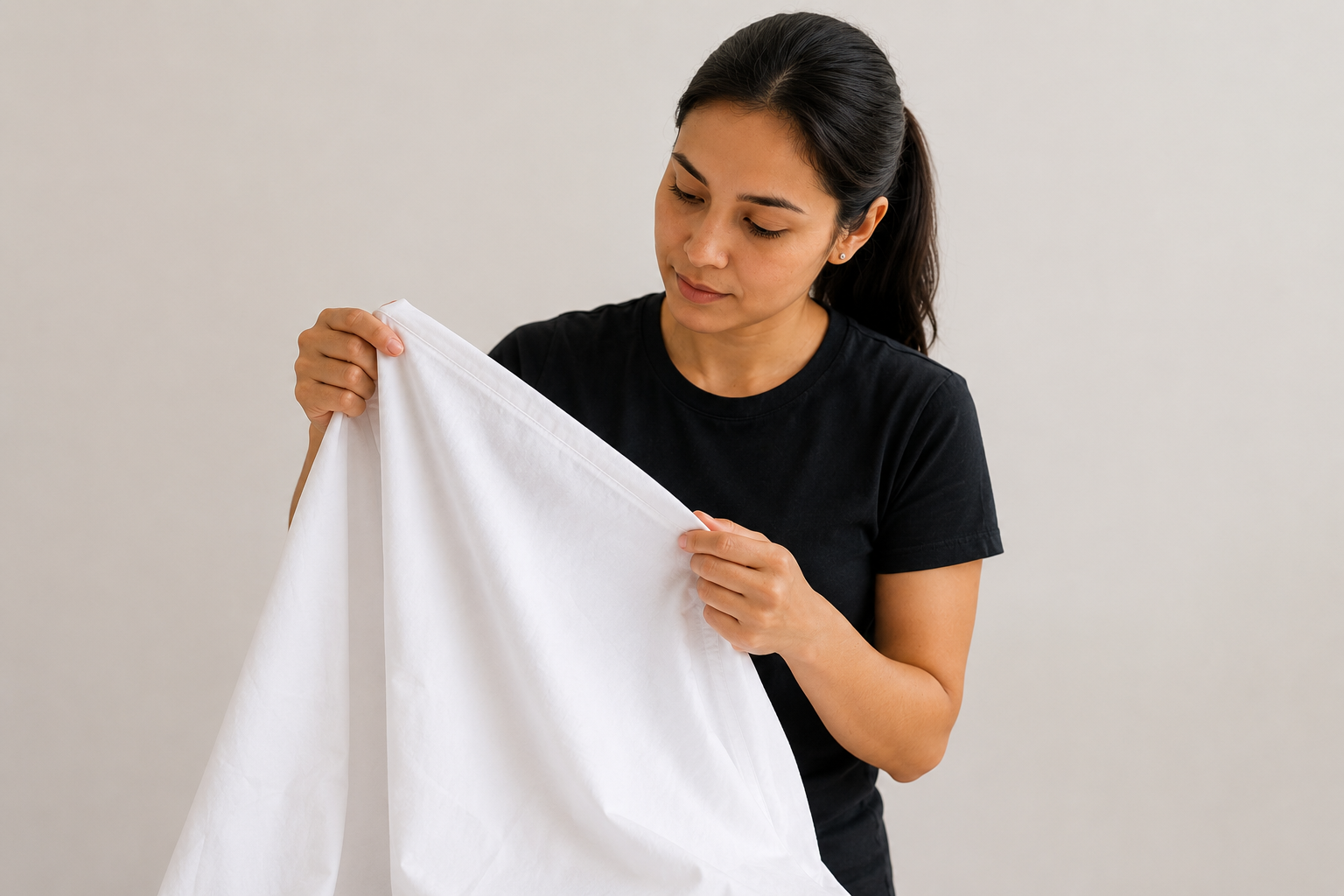
The best Airbnb sheets aren’t just comfortable. They’re built to handle repeat washes, quick turnovers, and back-to-back guests without losing their clean, crisp feel.
When hosts shop for the best sheets for an Airbnb rental, softness gets all the attention. Turnover performance deserves just as much.
Cotton-rich sheets feel soft and breathable, which guests notice. Cotton-poly blends trade a little of that hand-feel for better wrinkle resistance and wash durability, which matters when the same set goes through dozens of cycles a year. For a high-turnover rental, the blend often wins on total cost of ownership.
Color is a quieter decision that pays off daily. Airbnb's own guidance points to white towels because they're easiest to maintain and can always be bleached. The same applies to linens: keep whites separated from colors, pretreat stains, wash with an oxygen-based bleach, and run hot water when the fabric allows. White hides nothing — which is exactly why it stays looking clean. A stain on white gets treated; a stain on patterned linen gets overlooked until a guest finds it.
The practical rule: choose hotel-style white linens built for easy laundering, and avoid any bedding system that makes your turnover slower than it needs to be. The best sheet isn't the one that photographs well. It's the one that still looks crisp and guest-ready after its fortieth wash.
When to hand off laundry to a turnover service
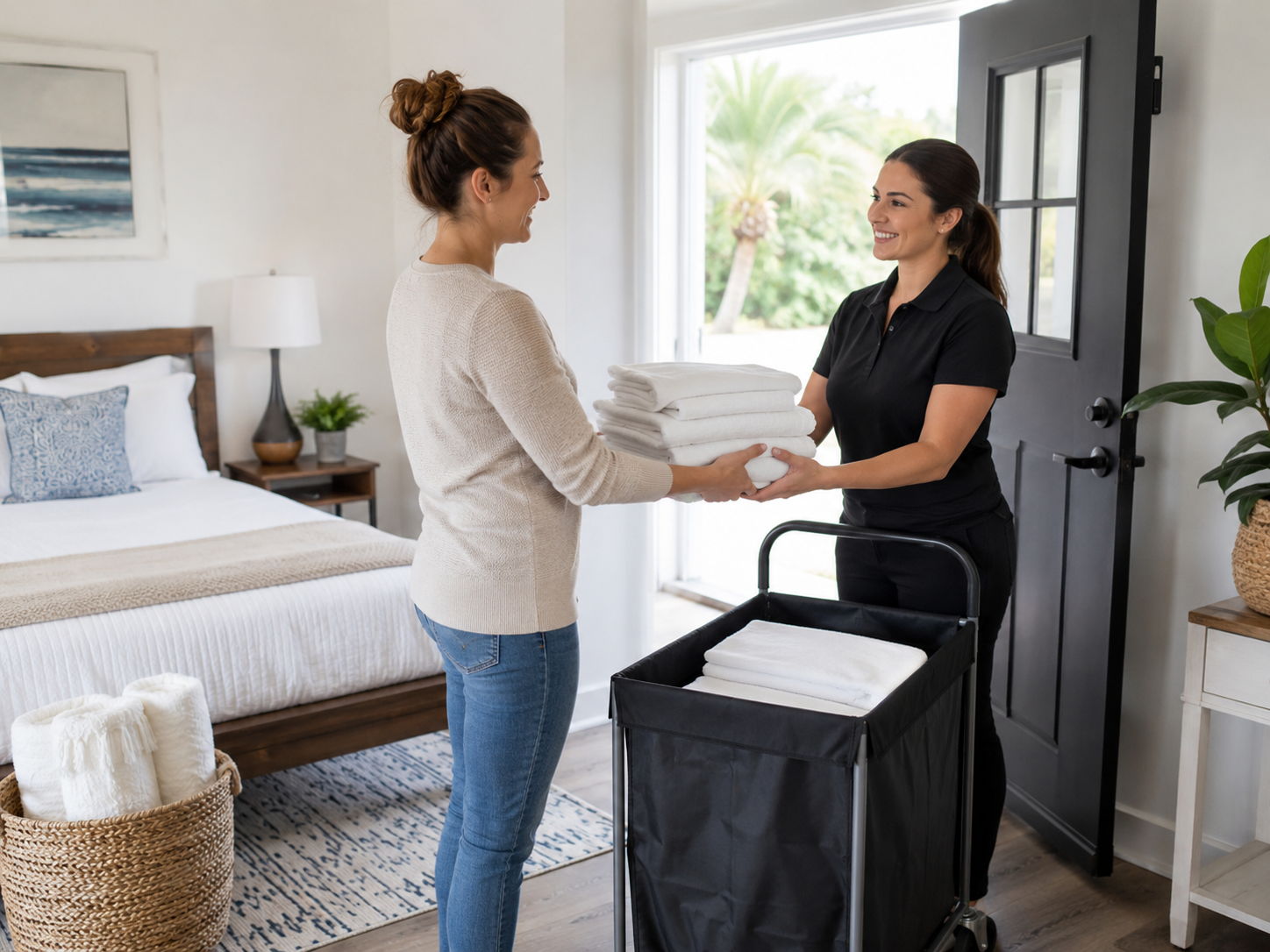
When laundry starts slowing down your turnovers, it may be time to hand it off and let a dedicated team keep the linen cycle moving.
At some point, the answer to "how do I keep up?" stops being "buy more sheets" and starts being "stop doing the laundry myself."
Laundry turnaround is the single biggest variable in setting your par level. On-site laundry lets you run lean at three par. Off-site laundry adds transport time on both ends, which is why operators who ship linens out typically move to four par to cover the gap. If your system breaks every time there's a late checkout, a stain, or a same-day arrival, more inventory only patches the symptom. The fix is pairing the right amount of inventory with a turnover team that keeps the linen cycle moving.
That's the lane HappyCleanBnB was built for. We handle Austin short-term rental turnovers end to end — same-day cleans, fresh linens, restocking, automated calendar-synced scheduling, and a manager-level final inspection — because a unit isn't guest-ready until the beds are remade, the towels are reset, and the property passes a final check. A real turnover includes bed stripping and remake, linen swaps or laundry, amenities restocking, and quality control, not just a surface wipe-down.
Why Austin hosts especially need reliable turnover support
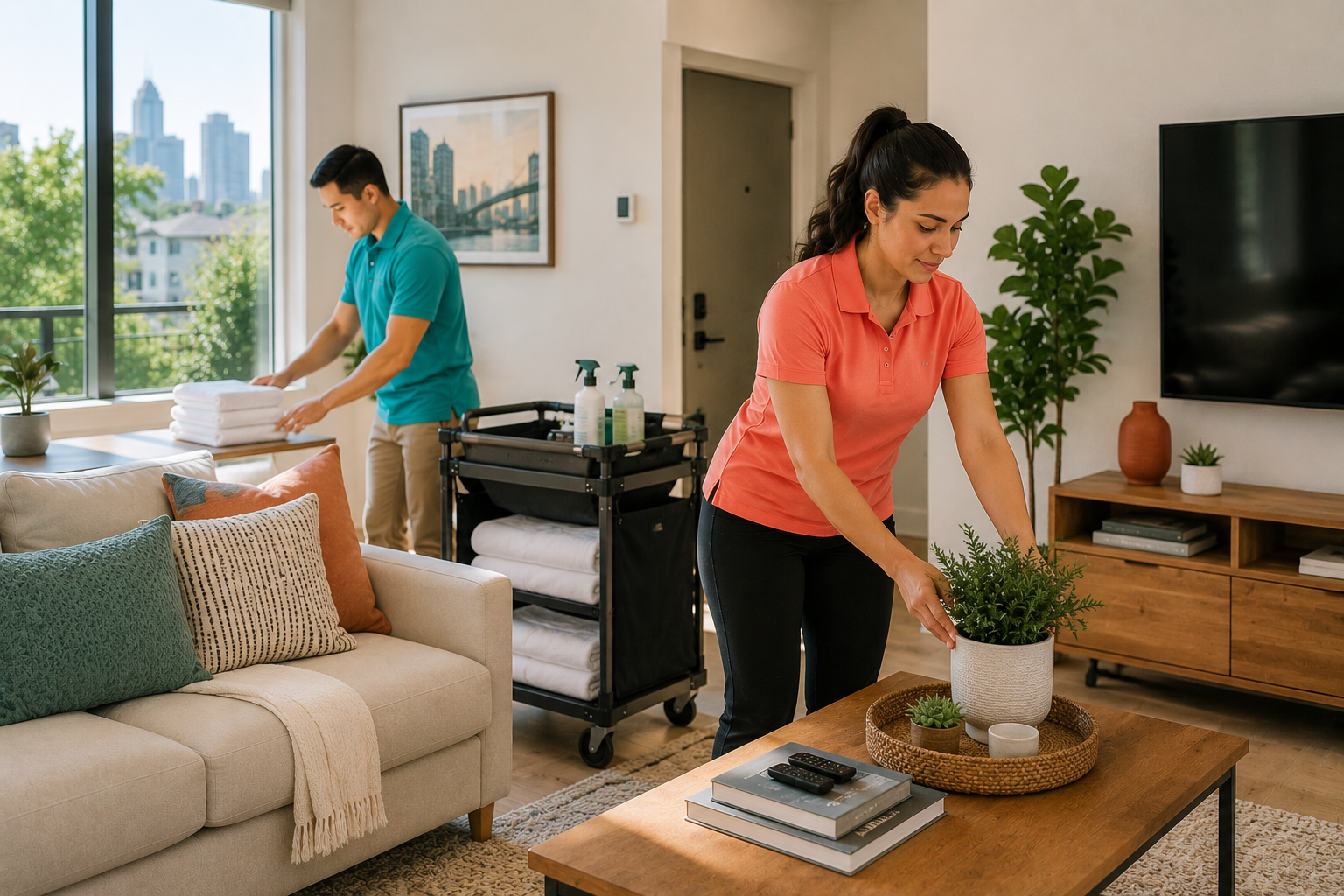
Reliable turnover support keeps every space guest-ready — from fresh linens to final touches, even when Austin hosting schedules get busy.
There's a local reason Austin hosts should treat turnover reliability as non-negotiable right now — and it has nothing to do with linens directly.
The City of Austin overhauled its short-term rental rules in September 2025, with operator requirements effective October 2025 and platform enforcement beginning July 1, 2026. Starting on that date, booking platforms — Airbnb, VRBO, Booking.com — must display a valid STR license number on every Austin listing, remove unlicensed properties within 10 days of a city request, and stop facilitating bookings for properties without a valid license. For an unlicensed operator, that means losing access to the platforms that drive nearly all of your bookings.
The city also requires a local contact who lives in the Austin metro area — Travis, Williamson, Hays, Bastrop, or Caldwell County — and who can respond promptly to complaints.
This doesn't turn a linen article into a legal one. It just raises the stakes on execution. A licensed Austin STR needs more than a cleaner — it needs documented turnovers, dependable restocking, and someone local who can keep the property guest-ready on short notice. That's what specialization buys you over a general house-cleaning company that also happens to take Airbnb jobs.
The bottom line: how many sheet sets does an Airbnb need?
Three complete sheet sets per bed, plus towels sized to your maximum guest count and managed with the same par-level discipline. If you use off-site laundry, run back-to-back bookings, or host a premium stay, move to four. Size for full demand, buy white and durable, and treat laundry turnaround — not bed count — as the number that actually sets your inventory.
And when the system gets to be more than you want to manage solo, that's the point where professional turnover support pays for itself.
Hosting in Austin? HappyCleanBnB runs smoother turnovers for local hosts — fresh linens, restocking, quality checks, and as-needed support with no contract. Book a free call with HappyCleanBnB
