


“A final review brings cleaner and host together to confirm the property is clean, prepared, and ready for check-in.”
Your guest doesn't know your cleaner ran forty minutes late. They don't know the previous family of six used every towel in the house, or that nobody told you the patio was covered in cedar pollen. They only know what they see when they open the door.
That's the problem with hiring "a cleaner" for a short-term rental. A clean house and a guest-ready house are not the same thing, and the gap between them is where bad reviews, refund claims, and 9 p.m. panic texts live.
This guide covers what to expect from an Airbnb cleaning service that actually understands hospitality: the scope they should own, the checklist they should follow, the communication you should get, and the questions that separate a true turnover partner from a residential cleaner who happens to take Airbnbs.
Key takeaways
A turnover is a reset, not a clean. Expect linens, restocking, staging, condition reporting, and a final inspection, not just vacuuming and wiping.
Scope should be written down before the first checkout. "Turnover cleaning" means different things to different companies.
Airbnb's own guidance calls for a thorough clean between every guest, a backup cleaner, and a property-specific checklist. Use those as your minimum bar.
Cleanliness failures carry real cost: under Airbnb's Rebooking and Refund Policy, a home that isn't reasonably clean at check-in is a covered Reservation Issue, and refunds come out of your payout.
"Done" is not a status. Expect photos, a completed checklist, and a flagged list of anything that needs your attention before the next arrival.
A turnover is a reset, not a house clean
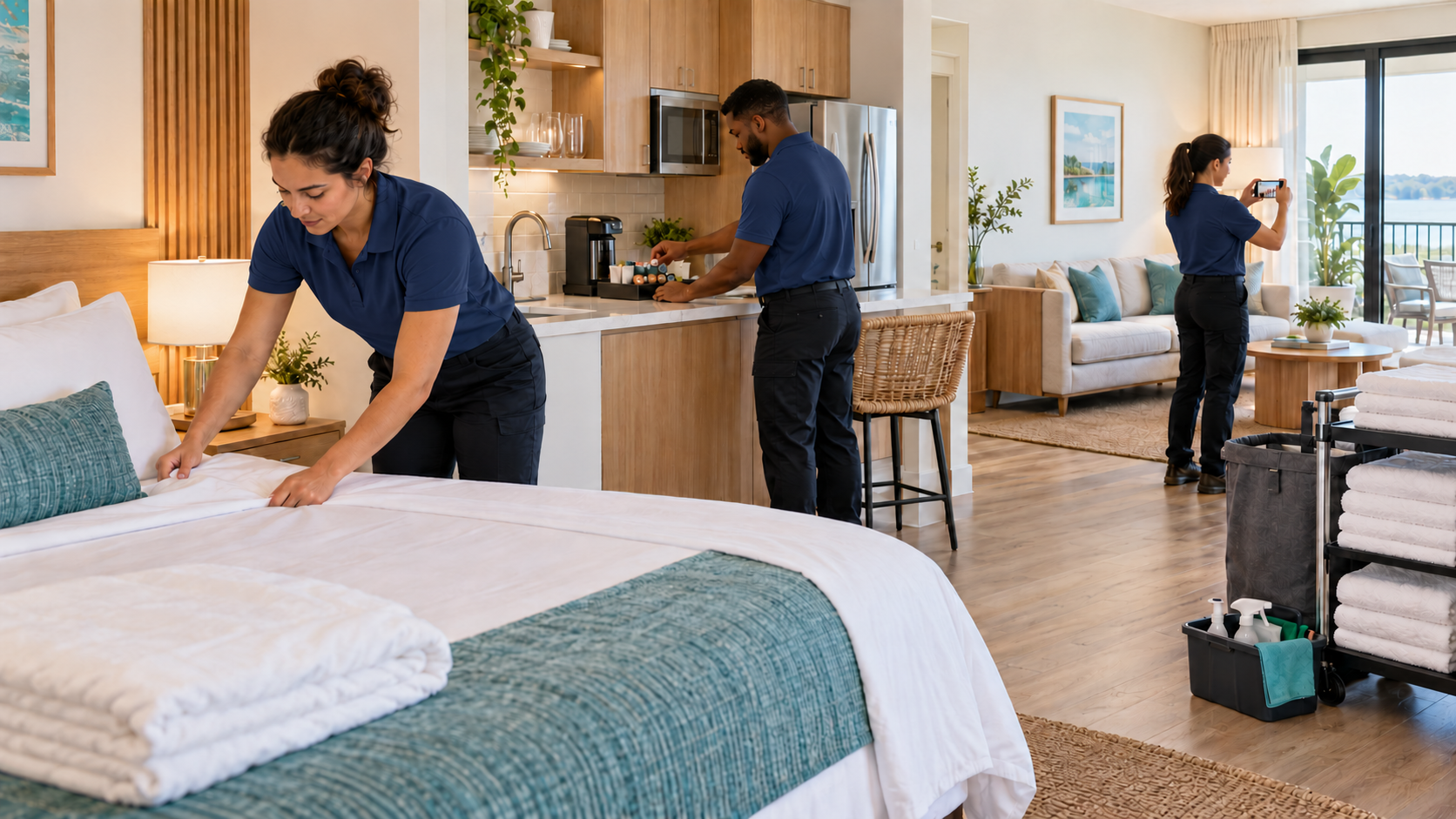
“Every detail matters between stays—from neatly made beds and replenished supplies to a final photo check of the finished space.”
A residential cleaner shows up weekly to make an occupied home nicer. A turnover crew shows up after checkout to rebuild a hospitality product from scratch, often in a four- or five-hour window before the next guest arrives.
That distinction changes everything about the job. The crew has to evaluate what happened during the stay, strip and replace linens, clean every room, restock consumables, restage the home to match your listing photos, document the result, and have it all done before check-in. Every stay, regardless of whether the last guest was a tidy business traveler or a bachelorette party.
Airbnb's hosting guidance is blunt about this. Its "Ensuring your place is sparkling clean" article says a clean space is the most important part of five-star hospitality and that every listing must be thoroughly cleaned between every guest, every time. It also tells hosts who use cleaners to run through the process themselves once, leave enough time between bookings, and line up a backup cleaner for the day the regular one can't make it.
Cleanliness is also one of the six categories guests rate separately after a stay (alongside accuracy, check-in, communication, location, and value), so a missed turnover shows up as its own line item on your profile.
The financial reason to take this seriously
Under Airbnb's Rebooking and Refund Policy for homes, a listing that is "not reasonably clean and sanitary" at check-in qualifies as a Reservation Issue. Guests have 72 hours after discovering the problem to report it. Depending on severity and evidence, Airbnb can issue a partial or full refund or rebook the guest elsewhere, and the host's payout is reduced by whatever was refunded.
In other words, a single bad turnover can cost you the whole booking, not just the review. That's why the standard for a cleaning partner is not "did they clean?" but "would I stake this reservation's payout on their work?"
What an Airbnb cleaning company should be responsible for

“The right cleaning company helps ensure your rental is spotless, organized, and ready to match the promise of your listing.”
The most common outsourcing mistake is assuming everyone defines "turnover" the same way. They don't. Get the scope in writing before the first reservation turns over, and make sure it covers these seven areas.
1. A full clean after every checkout
Airbnb's published host checklist is a good baseline: all surfaces dusted and cleaned, floors vacuumed or swept and mopped, trash removed, leftover food cleared from the fridge, dishes and cookware clean, fresh linens and towels on every bed and in every bathroom, bathrooms and kitchen appliances cleaned, and soaps refilled. If a provider's standard scope doesn't cover all of that, you're not buying a turnover.
2. Beds and bathrooms fully reset, not straightened
Used linens come off, clean linens go on, beds are made to your listing standard, and towels are replaced with a full fresh set. Airbnb's guidance adds the detail most cleaners skip: use a lint roller on bedding, and check the commonly missed zones such as under beds, inside drawers, cabinet fronts, entryways, and patios.
3. A kitchen ready for immediate use
Counters, sink, stovetop, microwave, fridge interior, dishes, cookware, utensils, trash with a fresh liner, and any food the last guest left behind. The test is simple: could a guest walk in and cook dinner without touching a single dirty item?
4. Consumables checked against par levels, not eyeballed
Airbnb's professional hosting guidance recommends having cleaners report low inventory so it can be replenished on the next turnover. Your agreement should define what's always present (toilet paper, paper towels, hand soap, dish soap, shampoo, coffee), how much backup stock lives on-site, and who buys replacements when the owner's closet runs low.
5. Condition reporting
Your cleaner is usually the first person inside the property after checkout. A wobbly chair, a stained duvet, a missing remote, a dripping faucet, or an unusually heavy mess isn't technically a cleaning task, but it is a hosting problem, and you need to hear about it before the next guest does. Airbnb also recommends documenting suspected guest violations, which is only possible if someone on-site is taking photos and notes.
6. Staging back to the listing
Pillows reset, furniture returned to position, throws folded the same way as in your photos, welcome materials arranged. The goal isn't just "clean." It's "indistinguishable from the listing the guest booked."
7. A final inspection before the job is called done
A checklist tells a crew what should happen. Quality control confirms it did. Expect either a second person (a lead or manager) to walk the property, or at minimum a structured photo review before the crew leaves.
Cleaning, sanitizing, and disinfecting are not the same thing
A professional team should also know the difference between these three, because "more chemical" doesn't mean "more clean."
According to the CDC's household cleaning guidance, cleaning physically removes dirt and most germs with soap and water; sanitizing lowers remaining germs to a safe level; disinfecting uses chemicals to kill what's left. The CDC says to clean first, because dirt interferes with sanitizers and disinfectants, and notes that routine disinfection of a home is generally unnecessary unless someone has been sick. For a turnover crew, that means: clean everything, sanitize or disinfect high-touch surfaces and bathroom fixtures according to the product label, and skip the theater of fogging an entire house.
The Airbnb turnover cleaning checklist hosts should expect
Every property needs its own checklist, because every property has different beds, appliances, outdoor spaces, and supply levels. Airbnb's professional-hosting guidance explicitly recommends customizing turnover checklists per listing. Here's the workflow a good one follows.

“A professional turnover is a full-property reset—not just a quick clean between reservations.”
Turnover cleaning is not deep cleaning
A professional company should also tell you when a standard turnover isn't enough.
A turnover restores guest readiness between stays. A deep clean handles what doesn't fit in a compressed checkout-to-check-in window: baseboards, vents, grout, window tracks, behind and under appliances, oven and fridge interiors, upholstery extraction. Most Austin properties with steady bookings need one every four to eight weeks.
Airbnb draws the same line from the guest side. Its ground rules for guests say the host's cleaning fee covers standard between-stay cleaning such as laundry and vacuuming, and that guests shouldn't leave a home requiring excessive or deep cleaning. So when a checkout involves smoke, pet accidents, or a party, you and your cleaner should both already know what triggers an additional charge and how it gets documented for a damage claim.
Ask any provider two questions: "What exactly is in a standard turnover?" and "What triggers an upcharge, and how will I know before I'm billed?"
Communication: "done" is not a status
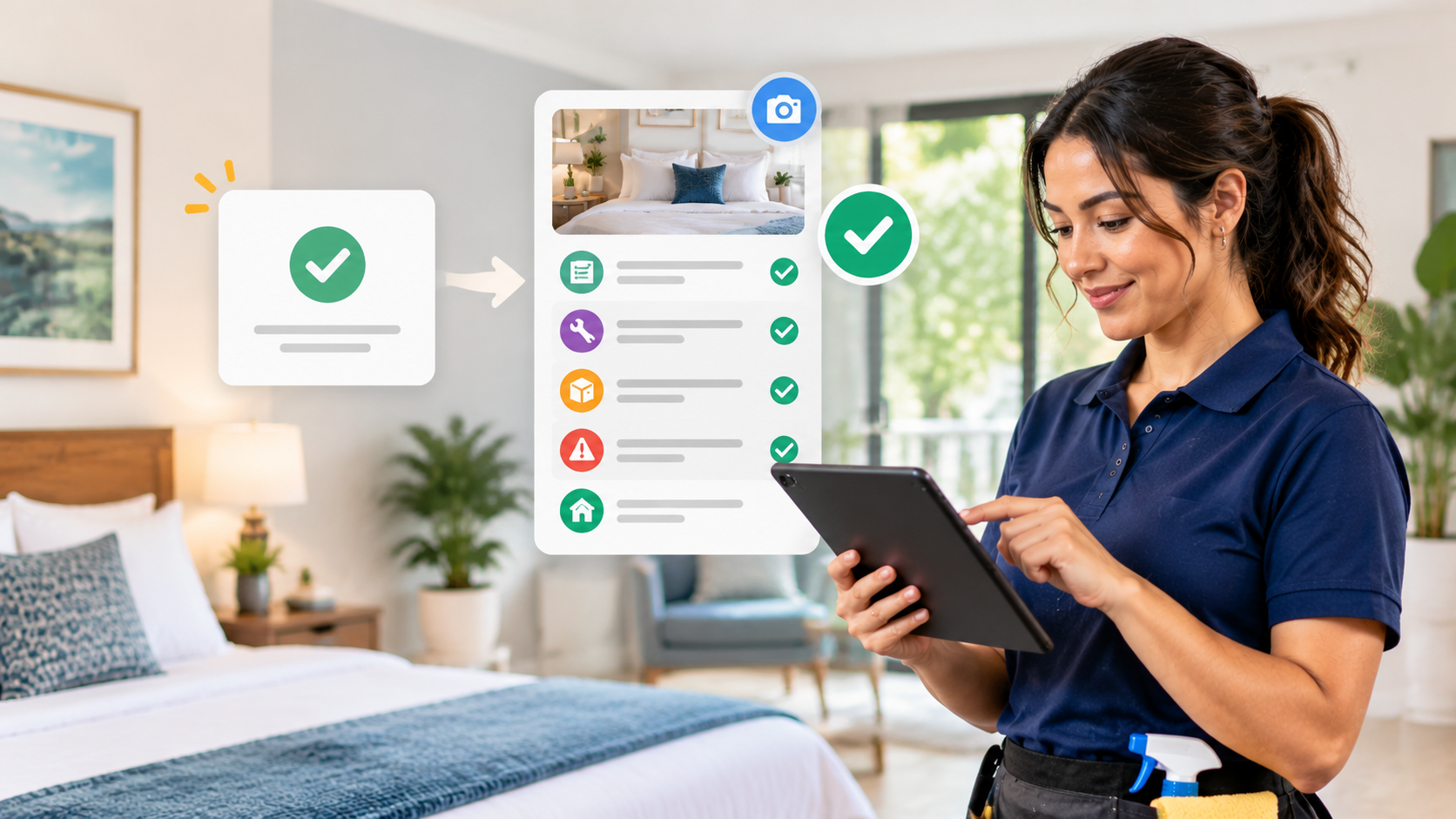
“Done” only tells us the task stopped. A good update tells us what happened.”
For an out-of-town host or anyone running more than one listing, the systems around the cleaning matter as much as the cleaning itself.
There are really two questions after every checkout:
Was my property cleaned?
Do I know it's ready for the next guest?
A text that says "done" answers the first and not the second. Here's what you should expect instead.
Before-and-after photos. Timestamped shots of every room at completion. These are your proof of condition if a guest files a cleanliness claim, and your evidence if the previous guest caused damage.
A completed checklist. Not a verbal confirmation. A record you can look at six months later when a review mentions the bathroom.
A flagged issues list. Anything the crew noticed that isn't a cleaning task: damage, low inventory, maintenance, odors. Delivered the same day, not mentioned next week.
Calendar-driven scheduling. If you're still texting your cleaner every booking, you're the single point of failure. Any serious STR provider should accept an iCal feed or connect to your PMS so turnovers get created from reservations automatically, with same-day turns handled as a defined workflow rather than a favor.
A backup plan. Airbnb says to have one. Ask the provider directly: "If my assigned cleaner is sick on a same-day turn, what happens?" If the answer involves you finding someone, that's not a cleaning company. That's a freelancer.
Expect the crew to be your early-warning system
Professional cleaners spend more time inside a remote-managed rental than the owner does. They are uniquely positioned to catch the burned-out bulb, the loose handle, the stained duvet, the pool that's turning green, and the trash bin that never made it to the curb.
Not every cleaning company fixes those things, and that's fine. But every professional one should have a defined reporting path, and the better ones will offer to handle the small operational jobs (bin roll-out, pre-arrival inspections, minor repairs, supply runs) so you're not coordinating a third vendor for a ten-minute task.
How to choose an Airbnb cleaning company
Stop asking "How much do you charge to clean my house?" Ask "How do you make my property completely guest-ready between two reservations?" The answer tells you everything.
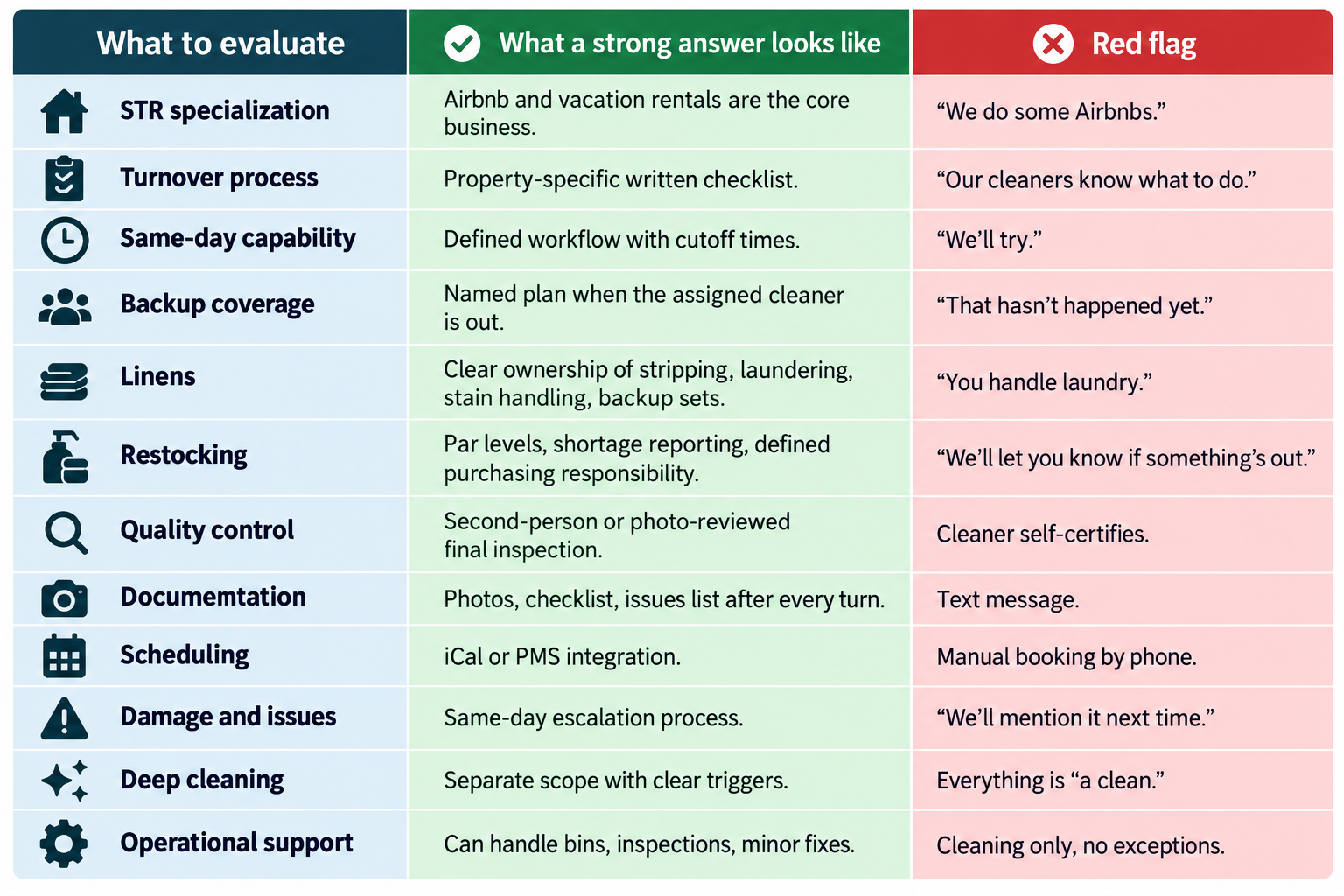
Use this vetting table. A strong answer in the right column is the bar; a vague answer is a flag.
"Airbnb cleaners near me" is the wrong search
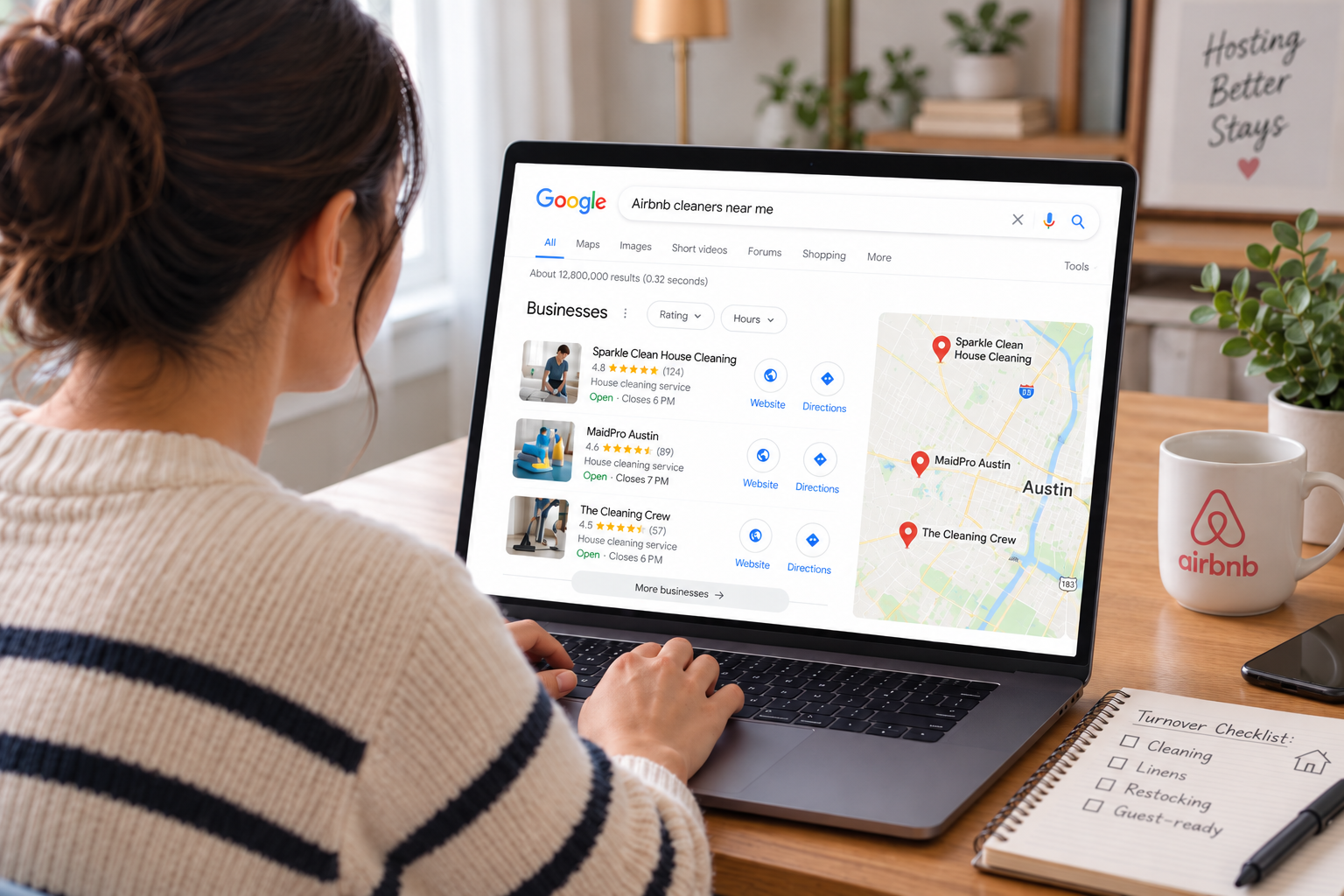
“The closest cleaner isn’t always the right cleaner—look for proven STR experience, then proximity. Vet your turnover partner before your next guest does.”
Proximity is useful. It's not qualification. A cleaner can be excellent at residential work and still be wrong for a short-term rental, because the job is different: hard deadlines, linen logistics, par-level restocking, staging to photos, documentation, and a guest who will rate the result within 48 hours.
When you compare local options, look past generic home-cleaning reviews. Ask whether the provider already runs back-to-back bookings, how they handle a 10 a.m. checkout with a 3 p.m. check-in, and what their last damage report looked like. Specialization first, then distance.
What this looks like in Austin
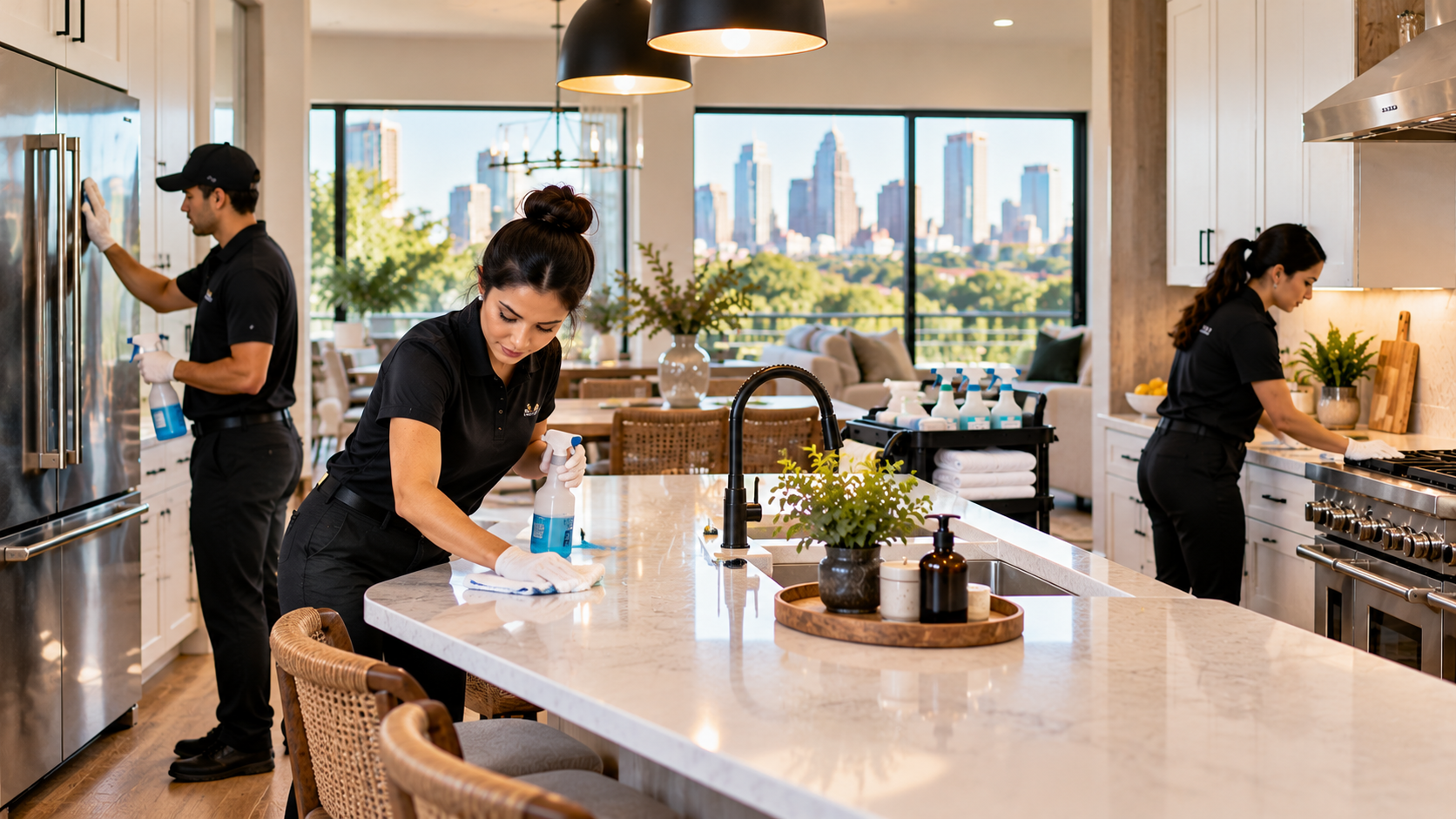
“Your Austin rental deserves more than a basic clean—choose a team built for short-term rental turnovers, not just housekeeping.”
HappyCleanBnB was built by short-term rental operators specifically because conventional cleaning companies didn't have the processes above. The company works exclusively with short-term and vacation rentals in Austin and surrounding communities.
The standard turnover model includes same-day turns, fresh linen resets, guest-supply restocking against agreed par levels, property-specific checklists, before-and-after photo reports, incident and restock records, a final quality check by a lead or owner before check-in, and iCal-compatible scheduling so turnovers are created from your reservation calendar. Deep cleaning is scoped separately with clear triggers.
For hosts who want fewer vendors, HappyCleanBnB also offers à-la-carte operational support: trash-bin roll-out, lawn and brush maintenance, pool and hot-tub checks, minor handyman work, supply management, pre-arrival inspections, and general errands. Service runs on a flexible basis with no long-term contract required, for a single property or a growing portfolio.
The real standard: would you trust them with your next check-in?
Your cleaning partner eventually becomes part of your reputation. The guest never sees the process. They see the result, and they rate it.
So measure a cleaning company against the guest-ready outcome, not the labor completed. Clean property. Fresh linens. Stocked essentials. Consistent staging. Documented condition. Inspected before arrival. Every stay, regardless of what the last guest left behind.
If your current provider can't show you that on every turnover, you don't have a turnover partner yet. You have a cleaner.
Ready to take turnovers off your plate? See how HappyCleanBnB handles Austin short-term rental turnovers and request a walkthrough of your property. We'll build the checklist with you before the first checkout.
