

Hourly vs. Flat-Rate Airbnb Cleaning: Which Pricing Model Actually Protects Your Margins?

A spotless stay starts with the right balance of time and cost.
A $45-an-hour cleaner and a $145 flat-rate turnover can end up costing you the same amount—or the hourly option can cost twice as much after a rough checkout. The hourly rate is the number hosts compare first, and it's the one that tells you the least.
If you're trying to figure out what Airbnb cleaning should cost, or whether to pay by the hour or per turnover, this guide walks through the 2026 numbers (national and Austin), what a real turnover includes, and which pricing model fits which situation.
Key takeaways
Flat-rate, per-turnover pricing is the better operating model for recurring Airbnb turnovers because it makes your cost per reservation predictable.
Hourly pricing still earns its keep for first cleans, deep cleans, and abnormally messy checkouts, where nobody can estimate the work in advance.
The best structure for most hosts is a fixed standard turnover price plus clearly defined add-ons for anything outside normal scope.
Compare quotes on total delivered turnover cost—labor, linens, restocking, inspection—not the headline hourly number.
In 2026, Airbnb turnovers commonly run $75–$250 nationally; Austin one- to three-bedroom turnovers mostly land between $80 and $230 depending on scope.
What does Airbnb cleaning cost in 2026?
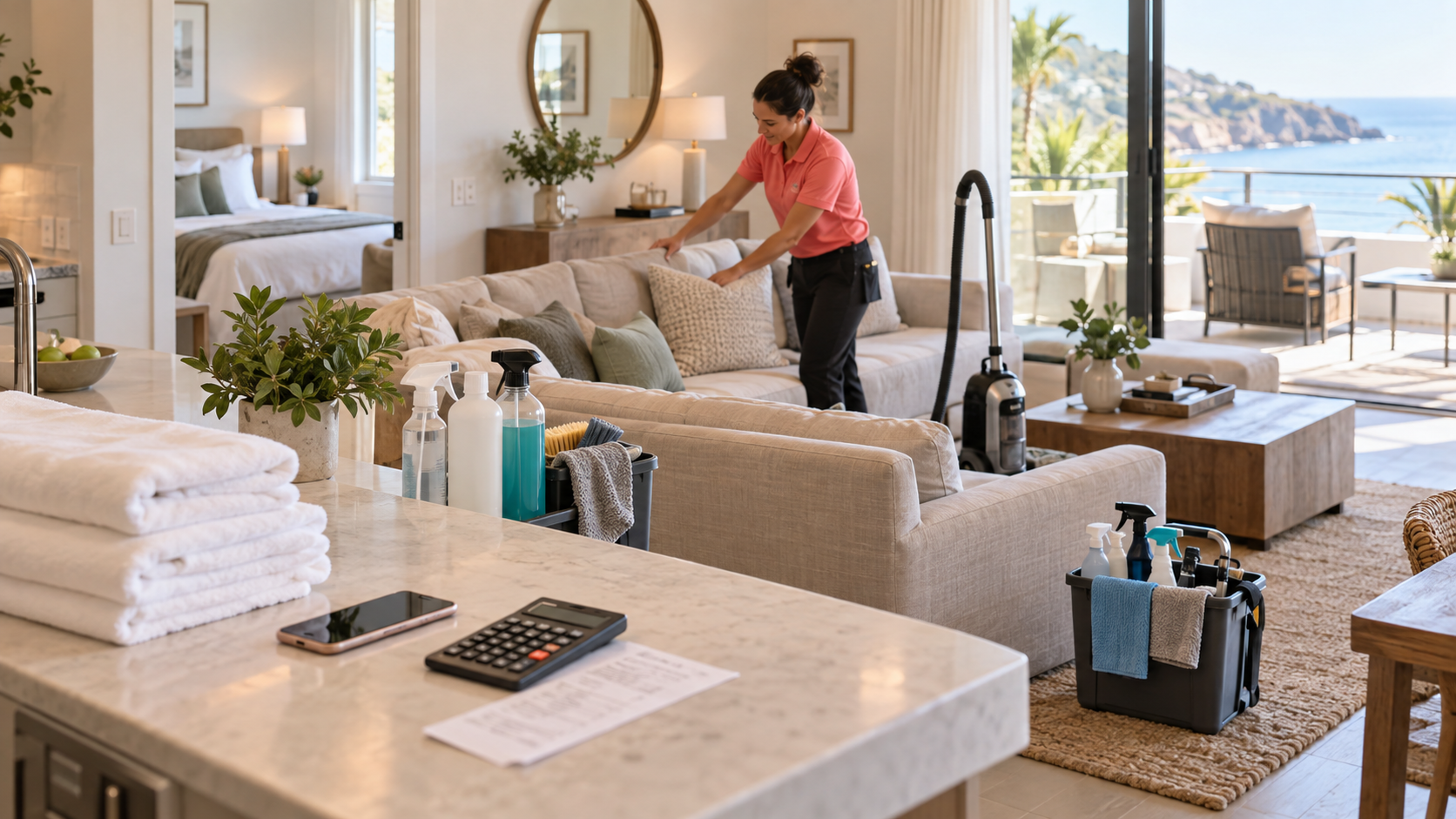
Spend smarter on Airbnb Cleaning in 2026—and keep more of your revenue.
The short answer: it depends on what's included in the turnover, and that's not a dodge. Two cleaners can quote the same property $90 and $140 and both be pricing fairly, because they're pricing different jobs.
National benchmarks
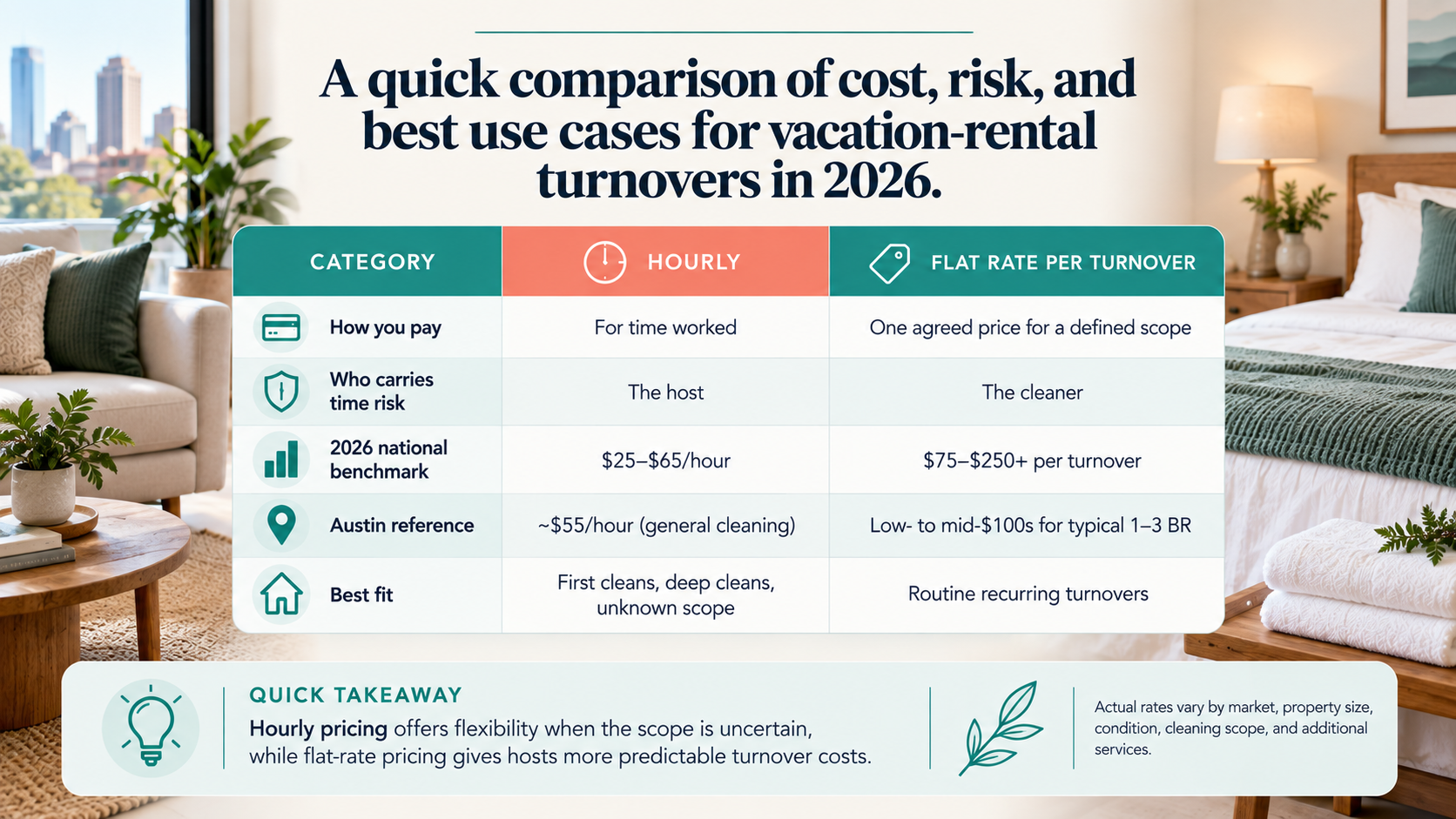
HomeGuide's April 2026 cost data puts professional Airbnb cleaning at roughly $75 to $250 per turnover, with larger properties running $250 to $400 or more. Hourly Airbnb cleaners commonly charge $25 to $65 per hour. HomeGuide also notes that flat per-turnover pricing is the most popular model among hosts because it makes each reset a predictable, plannable expense.
Austin benchmarks
Austin runs above many national averages. Angi's Austin house-cleaning data lists an average hourly rate of about $55 (with a wide $20–$110 spread), an average visit around $169, and most flat-rate jobs between $120 and $232. Those figures cover general residential cleaning, not Airbnb turnovers, but they show the labor market your STR cleaner is operating in.
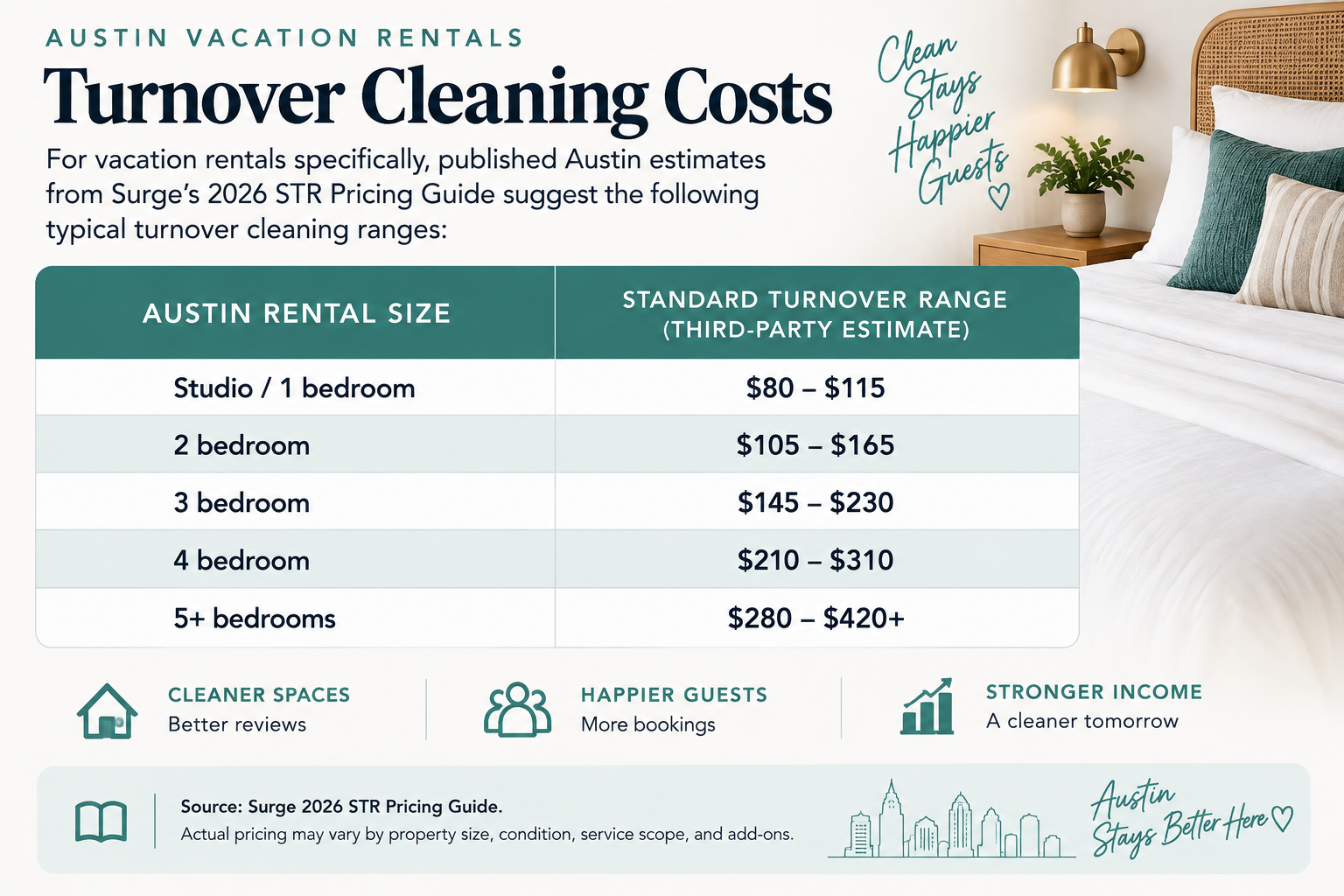
HappyCleanBnB's own 2026 Austin market survey found a tighter band: roughly $90–$100 for a studio or small one-bedroom, $120–$150 for a two-bedroom, and $150–$180 for a three-bedroom. Treat all of these as planning ranges, not quotes.
Why two pricing guides give two different answers
Bedroom count is only one variable. The others move the number just as much:
Bathrooms and square footage. A 2BR/2.5BA townhouse takes longer than a 2BR/1BA apartment.
Bed count, not bedroom count. A two-bedroom with one king and one queen is a different reset than a two-bedroom sleeping eight with bunks and a sofa bed.
Linen handling. On-site laundry adds $15–$40 per turnover and often an hour of dryer time, according to HomeGuide.
Amenities. HomeGuide estimates a hot tub alone adds $25–$50 per turnover; patios and grills add $15–$30.
Timing. Same-day turns commonly carry a $20–$50 rush fee.
Pets, pools, and travel distance.
So the useful question for a quote isn't "what do you charge for two bedrooms?" It's "what does it cost to make this property completely guest-ready between reservations?"
The cleaner's invoice is not your cleaning fee
Hosts routinely conflate two numbers. Your cleaning cost is what you pay your cleaner—an operating expense. Your cleaning fee is what guests see on the listing—a pricing decision. Airbnb's Help Center lets hosts set both a standard cleaning fee and a lower short-stay fee for one- and two-night bookings, and Airbnb's host guidance recommends calculating your actual turnover costs and weighing the fee against your total guest price, since inflated fees suppress bookings.
For the fee side of the equation, see How Much Should You Charge for Your Airbnb Cleaning Fee? A 2026 Pricing Guide for Hosts. This article is about the cost side.
Hourly vs. flat-rate cleaning: who absorbs the variability?
Strip away the details and the two models come down to one question: when a turnover takes longer than expected, who pays for the extra time?
How hourly Airbnb cleaning works
You agree on a rate and pay for the labor the job requires. At $55 per hour, a two-hour clean costs $110. If the next guests leave a four-hour mess, it costs $220.
That's fair when neither side knows how long the job will take—a first visit to a property, a neglected unit, a post-event cleanup. Angi's Austin data reflects this: hourly pricing is more common for one-time and specialty work, while flat rates dominate routine, recurring cleaning.
The catch for an STR operator is that your cost per reservation changes every time, which makes your margin per booking a guess.
One quoting detail that trips up hosts: ask whether the hourly rate is per cleaner or per team. Two cleaners working two hours is four labor-hours. Angi notes that rates are often quoted per cleaner while companies send multiple people, so a "$55/hour" quote can mean $110/hour on the clock.
How flat-rate Airbnb cleaning works
The provider estimates the normal labor for your property and quotes a set price for the standard turnover. If your two-bedroom is quoted at $145, the invoice is $145 whether the crew finishes in 1 hour 45 minutes or 2 hours 20 minutes.
That's why flat pricing is attractive: your short-term rental cleaning cost becomes a fixed line item you can plug into every reservation's economics.
But "flat rate" should never mean "unlimited cleaning." A professional agreement defines what a standard turnover includes and what happens when a property is left outside that scope. Pet accidents, parties, excessive trash, smoke, heavy staining, or several hours of unexpected work reasonably sit outside a standard reset. Published Austin pricing research lists pet cleaning, laundry, hot-tub and pool work, outdoor areas, supply runs, and unusually dirty units as common add-ons.
The arrangement that works best for most professional STRs:
A predictable standard turnover price, paired with clearly defined add-ons or overage procedures for anything outside normal scope.
You get the budgeting advantage of flat pricing without subsidizing the one guest a quarter who trashes the place—and your cleaner isn't pressured to rush a bad checkout to hit a number.
Which pricing model is better for Airbnb hosts?

Smarter cleaning pricing can help hosts lower costs and protect every booking’s profit.
For routine, repeatable short-term-rental turnovers, flat-rate pricing wins. Here's the reasoning, since it isn't only about cost.
An Airbnb turnover is a deadline with a defined outcome. A residential cleaning job is "clean the house." An STR turnover is "make this property completely guest-ready by 3 p.m." You're buying a result, not a block of time. Flat pricing matches the transaction to what you actually need.
Predictability compounds across your business. When each standard turnover costs a known amount, you can set minimum stays, price one-night gaps, calculate your cleaning fee, and forecast margin per booking. Airbnb's own guidance—calculate your real cleaning costs, then evaluate the fee against bookability—is only workable if the underlying cost is stable.
Efficiency stops being a conflict. Under hourly pricing, a cleaner who gets faster earns less. Under flat pricing, the cleaner can invest in training, checklists, and better sequencing, and the host doesn't wonder whether a slow day will double the invoice.
The one condition: flat pricing only works when quality control exists. A flat-rate cleaner with no checklist, no photo verification, and no inspection can benefit from cutting corners. So evaluate the system behind the price, not just the number. "Done in two hours" and "guest-ready in two hours" are not the same thing.
When hourly still makes sense
Hourly or separately quoted pricing is the right call in four situations:
The first or baseline clean. Until a cleaner has seen the property, a repeatable turnover price is a guess.
Deep cleans. Appliance interiors, baseboards, window tracks, and built-up grime aren't part of a checkout reset. LeadDuo's 2026 rate data puts deep cleans at 1.8–2.5× the standard turnover for the same property.
Abnormally dirty checkouts. When a guest creates hours of work beyond normal, a predefined overage charge is fairer than baking that risk into every standard turnover.
Nonstandard project work. Organizing, post-maintenance cleanup, or a one-off reset that doesn't resemble a guest turnover.
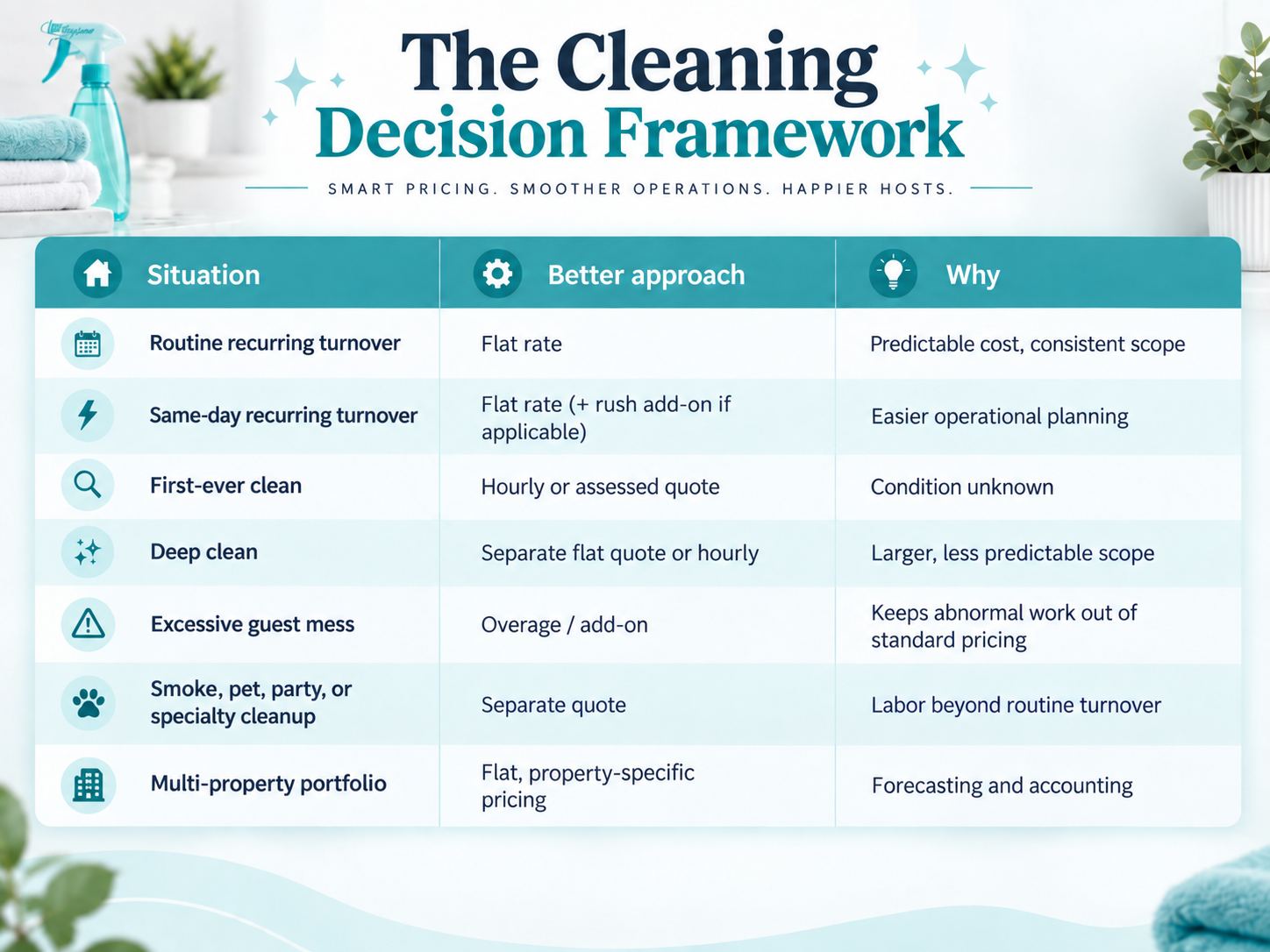
The winner in the hourly-vs-flat-rate debate isn't unlimited flat pricing. It's a clearly scoped, predictable turnover price with transparent exceptions.
Why the lowest quote isn't the lowest turnover cost
True turnover cost is about more than the initial cleaning quote.
This is where hosts get trapped.
Cleaner A charges $45 per hour. Cleaner B quotes a higher all-in turnover. Cleaner A looks cheaper. Now run the full checklist:
Who strips, launders, and remakes the beds?
Who confirms shampoo, soap, coffee, and toilet paper were restocked?
Who notices the broken chair, the stained duvet, the thermostat left at 62°F?
Who photographs the property so you have proof of condition before the next guest walks in?
Who covers a back-to-back turn when your cleaner is sick?
Every "nobody" on that list is a task that lands on you—or a problem your next guest discovers first. Turno describes STR turnover cleaning as a specialized process built on property-specific checklists, photo references, and scheduling, not a variant of house cleaning. BNBCalc's 2026 cost analysis makes the same point with numbers: a $65 clean that requires a $40 re-clean twice a month costs more than a reliable $100 clean that never misses.
Run the real math. A two-bedroom Austin turnover at the local $55/hour benchmark for 2.5 hours is $137.50 in labor—inside the published Austin two-bedroom range. But if the job needs two cleaners, includes laundry, restocks amenities, and gets a manager inspection, that $55 figure no longer describes what you're buying. The honest comparison is:
True turnover cost = cleaning labor + linen/laundry + restocking + supplies + inspection and quality control + any add-ons for abnormal conditions
Optimize for the lowest reliable cost of a complete, documented, on-time guest reset—not the lowest cleaning price. Those are different numbers.
There's a guest-facing reason to get this right, too. Airbnb's host guidance notes that guests weigh cleanliness and fair pricing heavily, and that guests who pay a separate cleaning fee scrutinize cleanliness even more closely. Every dollar of that fee needs to produce a property that feels worth it.
How HappyCleanBnB prices Austin turnovers
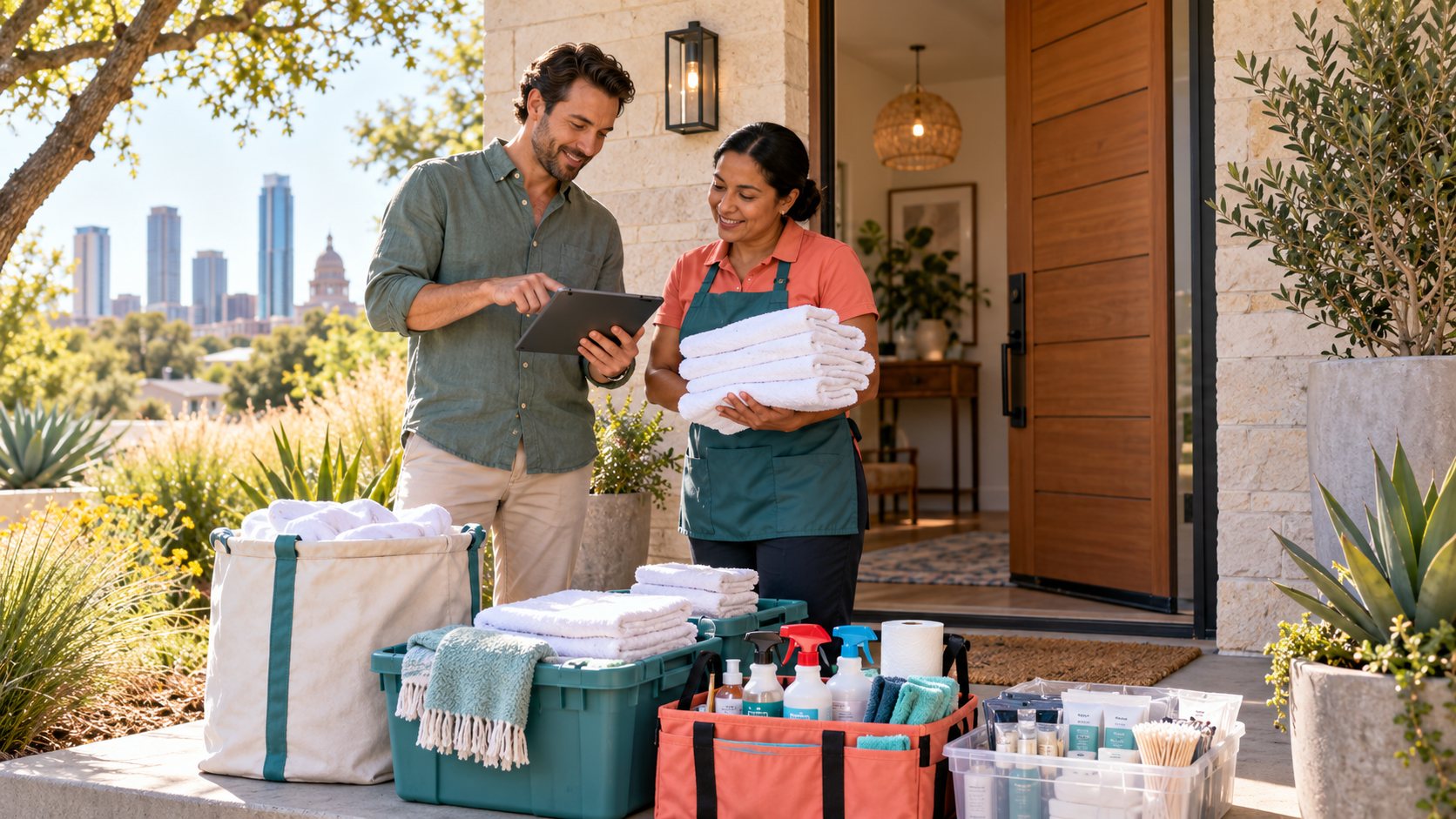
Austin turnover pricing should reflect the real work behind every clean—from linens and supplies to property size and turnaround needs.
We built HappyCleanBnB around the model described above: Airbnb, Vrbo, and short-term-rental properties in Austin, priced per turnover with a defined scope, not billed by the hour as an add-on to residential cleaning.
A standard turnover with us includes the reset itself, fresh linen changes, guest-supply restocking, before-and-after photo documentation, property-specific checklists, incident and restock records, and a final quality check. Reservation calendars can be synced so turnovers are scheduled automatically from booking activity rather than arranged by hand each time.
Work outside a normal reset—deep cleans, smoke or pet remediation, party cleanups—is quoted separately so it never inflates your standard rate. Hosts who want more operational coverage can add trash-bin roll-outs, lawn and brush maintenance, pool and hot-tub checks, handyman and minor-repair help, supply management, pre-arrival inspections, and general errands. We serve Austin and surrounding communities including Cedar Park, Dripping Springs, Spicewood, Leander, Round Rock, Georgetown, Buda, Kyle, Del Valle, and Bastrop, with no long-term contracts.
For a broader look at local pricing, see Comparing Airbnb Cleaning Costs Around Austin, TX in 2026. For how to vet any cleaner's process, see What Makes a Reliable Airbnb Cleaning Service?.
Frequently asked questions

How much do Airbnb cleaners charge? Nationally in 2026, roughly $75–$250 per turnover, with large properties at $250–$400+, per HomeGuide. Hourly Airbnb cleaners commonly run $25–$65 per hour. Austin studios and one-bedrooms typically fall around $80–$115 per turnover, two-bedrooms $105–$165, and three-bedrooms $145–$230, based on published local estimates.
What is a typical Airbnb cleaner hourly rate? About $25–$65 per hour nationally (HomeGuide). Austin's general house-cleaning average is around $55 per hour (Angi), with a wide spread. Always confirm whether the rate is per cleaner or per crew.
Is flat-rate Airbnb cleaning cheaper than hourly? Not automatically. Hourly can cost less on an unusually easy clean and substantially more on a hard one. Flat rate's value is predictability: with a properly scoped agreement, you know the normal per-turnover cost in advance.
What pricing model is best for a recurring Airbnb? A fixed standard turnover price with transparent pricing for add-ons and abnormal conditions. Reserve hourly or separate quotes for first cleans, deep cleans, and specialty remediation.
What should be included in an Airbnb turnover cleaning cost? At minimum, compare quotes on the same base scope: kitchen, bathrooms, floors, dusting, trash, fresh beds, and a basic reset. Then ask whether linens, laundry, restocking, staging, photo documentation, incident reporting, and a final quality check are included.
Why is vacation rental cleaning more expensive than regular house cleaning? Because it's reset on a deadline for a paying guest and includes work a maid service doesn't do: bed changes, laundry, restocking, staging, amenity checks, damage inspection, and condition documentation. Same-day windows, large homes, pets, pools, and rough checkouts add more.
Does the host have to charge guests what the cleaner charges? No. The cleaner's invoice and the listing's cleaning fee are separate decisions. Airbnb lets you set a standard fee plus a lower short-stay fee for one- and two-night bookings, and recommends weighing the fee against total guest price.
What should I look for when searching "Airbnb cleaners near me"? Skip the hourly rate and ask how they handle same-day turns, backup coverage, linens, restocking, property-specific instructions, photo verification, and damage reporting. Turno recommends prioritizing vacation-rental experience and reliability over price.
The verdict
For most established Airbnb and vacation-rental properties, a well-defined flat-rate turnover is the better operating model—not because it's cheaper on every clean, but because a short-term rental is a business and you need to know what each reservation costs to service.
Hourly pricing still belongs in your toolkit for the jobs nobody can estimate: first cleans, deep cleans, post-party resets, smoke issues. The strongest structure combines both: a predictable base turnover price plus clearly defined add-ons for anything outside normal scope.
Pricing is half the decision. The other half is whether the cleaner can reliably deliver a complete, documented, guest-ready reset every time.
Ready to see what a scoped turnover would cost for your property? Get a turnover cleaning quote from HappyCleanBnB and we'll price your specific property—bed count, bathrooms, linens, and amenities included—so you can plug a real number into your booking economics.
